
When Should a Property Management Company Outsource Its Accounting?

Discover when should a property management company outsource accounting, the warning signs to watch for, tasks to delegate and how to maintain financial control.

Property management finance team reviewing month-end accounting workload
Accounting Outsourcing

When Should a Property Management Company Outsource Its Accounting?

Managing a property portfolio involves much more than collecting rent and paying invoices. As a property management company grows, its accounting responsibilities become increasingly complex. More properties mean more transactions, vendor payments, reconciliations, owner statements, financial reports and records that need to be maintained accurately.

A small accounting team may be able to manage these responsibilities when the portfolio is relatively simple. But as the business expands, the same processes can become difficult to maintain. Month-end closes take longer, reporting gets delayed, routine accounting work consumes management time, and the team has less capacity to focus on financial oversight.

This is often when property management companies begin considering accounting outsourcing.

However, outsourcing is not necessarily the right solution for every company. The decision depends on the size and complexity of the portfolio, the capabilities of the existing team, the quality of accounting processes and the level of financial control the business needs to maintain.

In this guide, we explain when a property management company should consider outsourcing its accounting, which responsibilities can be delegated, what should remain under internal oversight and how to evaluate whether outsourcing is the right move.

Why Property Management Accounting Becomes More Difficult as a Business Grows

Property management accounting has requirements that extend beyond those of a typical small business.

A property management company may need to maintain financial records across multiple properties, ownership entities and bank accounts. It may also be responsible for recording rental income, tracking operating expenses, processing vendor invoices, reconciling accounts and preparing financial statements for owners.

As the portfolio expands, the accounting workload grows in several ways.

More transactions to process

Additional properties create more rent receipts, invoices, maintenance expenses, vendor payments and other financial activity. Each transaction needs to be recorded accurately and assigned to the correct property or entity.

More complex reporting

Property owners, investors and management teams may require different financial reports. Preparing consistent reports across a growing portfolio can become time-consuming without standardized accounting processes.

More reconciliation work

Multiple operating accounts, security deposit accounts, property-level ledgers and ownership entities can increase reconciliation requirements.

Demand for timely information

Management needs accurate financial information to monitor property performance, evaluate expenses, identify cash flow issues and make operational decisions.

Dependence on key personnel

When only one or two employees understand the entire accounting process, routine work can become vulnerable to staff absences, turnover and competing priorities.

The challenge is not simply that a company has more properties. It is that its accounting processes, staffing and systems may not have developed at the same pace as its portfolio.

Seven Signs Your Property Management Company Should Consider Outsourcing Accounting

There is no universal property count or revenue threshold at which a company should outsource its accounting. A company managing a relatively small but complex portfolio may need additional accounting support sooner than a larger business with highly standardized processes.

Instead of focusing only on portfolio size, look for the following warning signs.

01Your month-end close is consistently delayed

Month-end close is one of the clearest indicators of whether an accounting team has sufficient capacity.

The process typically involves recording transactions, reviewing accounts payable and receivable, reconciling bank accounts, reviewing general ledger balances, recording necessary adjustments and preparing financial reports.

When these activities consistently fall behind schedule, the problem may be insufficient staffing, inefficient workflows or a lack of clearly assigned responsibilities. Common warning signs include:

  • Bank reconciliations remaining incomplete well into the following month
  • Vendor invoices waiting too long to be entered or reviewed
  • Financial statements being distributed later than expected
  • Repeated adjustments after reports have already been prepared
  • Accounting employees spending excessive time correcting earlier entries

Outsourced accounting support can help manage recurring tasks such as transaction processing, reconciliations, account schedules and reporting preparation.

The objective should not simply be to close the books faster. It should be to establish a consistent and reviewable monthly accounting process.

02Your accounting team cannot keep up with portfolio growth

When a property management company adds properties, units or ownership entities, its accounting workload generally increases. However, hiring additional employees every time the portfolio expands may not be the most practical approach.

Your existing team may already be spending most of its time on recurring administrative tasks, leaving little capacity for more complex responsibilities. Consider outsourcing when:

  • Your transaction volume has increased substantially
  • New properties are creating additional bookkeeping and reconciliation work
  • Accounting employees are regularly working overtime
  • New portfolio additions are creating reporting backlogs
  • The company needs additional accounting capacity but is not ready to expand its permanent payroll

An outsourced accounting team can provide additional operational capacity while allowing internal employees to focus on review, financial planning and business decisions.

03Financial reporting is inconsistent or difficult to produce

Reliable financial reporting is essential for understanding property performance. Management teams and property owners need accurate information about income, expenses, outstanding balances and financial activity.

However, reporting can become inconsistent when different employees use different procedures, account classifications or reporting formats. You may need additional accounting support if:

  • Reports are prepared differently across properties
  • Management spends too much time checking figures before distribution
  • Property-level and portfolio-level reports do not reconcile
  • Expense classifications are inconsistent
  • Management cannot obtain financial information when it is needed

An outsourced accounting partner can help standardize recurring reporting workflows, maintain accounting records and prepare reports for internal review.

The company should still define reporting requirements, approve reporting policies and retain responsibility for reviewing financial results.

04Reconciliations and account reviews keep falling behind

Reconciliations are essential to maintaining accurate accounting records. Property management companies may need to reconcile operating bank accounts, security deposit accounts, accounts payable, accounts receivable, intercompany balances and other general ledger accounts.

When reconciliations are delayed, discrepancies can remain unresolved for extended periods. Common warning signs include:

  • Unidentified transactions appearing in bank reconciliations
  • Old outstanding items remaining unresolved
  • Balances requiring repeated adjustments
  • Differences between property management software and accounting records
  • Reconciliations being completed only when management requests them

An outsourced accounting team can support recurring reconciliation work, investigate identified discrepancies and maintain documentation for review.

However, reconciliation work should be supported by appropriate access controls, documented procedures and independent review.

05Your business depends too heavily on one or two employees

Some property management companies rely on a small number of employees who understand nearly every part of the accounting process. While this arrangement may work initially, it creates operational risk.

If a key employee leaves, takes extended leave or becomes unavailable, important accounting responsibilities may be interrupted. The company may also struggle to document processes because much of the knowledge exists only with individual employees.

Outsourcing can provide additional process continuity through documented workflows, assigned responsibilities and a team-based approach. Before engaging a provider, establish clear procedures for:

  • Task ownership
  • Review and approval
  • Supporting documentation
  • Escalation of discrepancies
  • Access to accounting systems
  • Backup coverage and handovers

The goal is to reduce dependence on individual employees without creating an uncontrolled dependence on an external provider.

06Your Controller or management team spends too much time on routine tasks

Controllers and senior finance professionals should be able to focus on financial oversight, reporting analysis, budgeting, internal controls and strategic decisions.

However, in a resource-constrained accounting department, senior employees may spend a disproportionate amount of time handling routine transaction processing and administrative work. For example, a Controller may be personally involved in:

  • Entering recurring transactions
  • Following up on missing invoices
  • Preparing routine reconciliations
  • Organizing supporting documentation
  • Updating recurring accounting schedules
  • Correcting data-entry errors

These tasks are important, but they may not require the full attention of senior finance personnel. Outsourcing appropriate processing responsibilities can free internal finance leaders to concentrate on review, analysis and financial management.

07Hiring and retaining accounting staff has become difficult

Recruiting experienced accounting employees can take time, particularly when a property management company needs people who understand property-level accounting, multiple entities and real estate financial reporting.

Staff turnover can also interrupt recurring accounting processes and increase the burden on remaining employees. Outsourcing may be worth evaluating when:

  • Accounting vacancies remain unfilled for extended periods
  • Recruitment and training repeatedly disrupt operations
  • The company needs specialized accounting support
  • Workload fluctuates throughout the year
  • Permanent staffing costs are difficult to justify for the required volume of work

An outsourced model can provide access to additional accounting resources without requiring the company to recruit every role internally.

However, outsourcing should be evaluated on the quality, consistency and total cost of the service—not simply on the hourly cost of labor.

Which Accounting Responsibilities Should a Property Management Company Outsource?

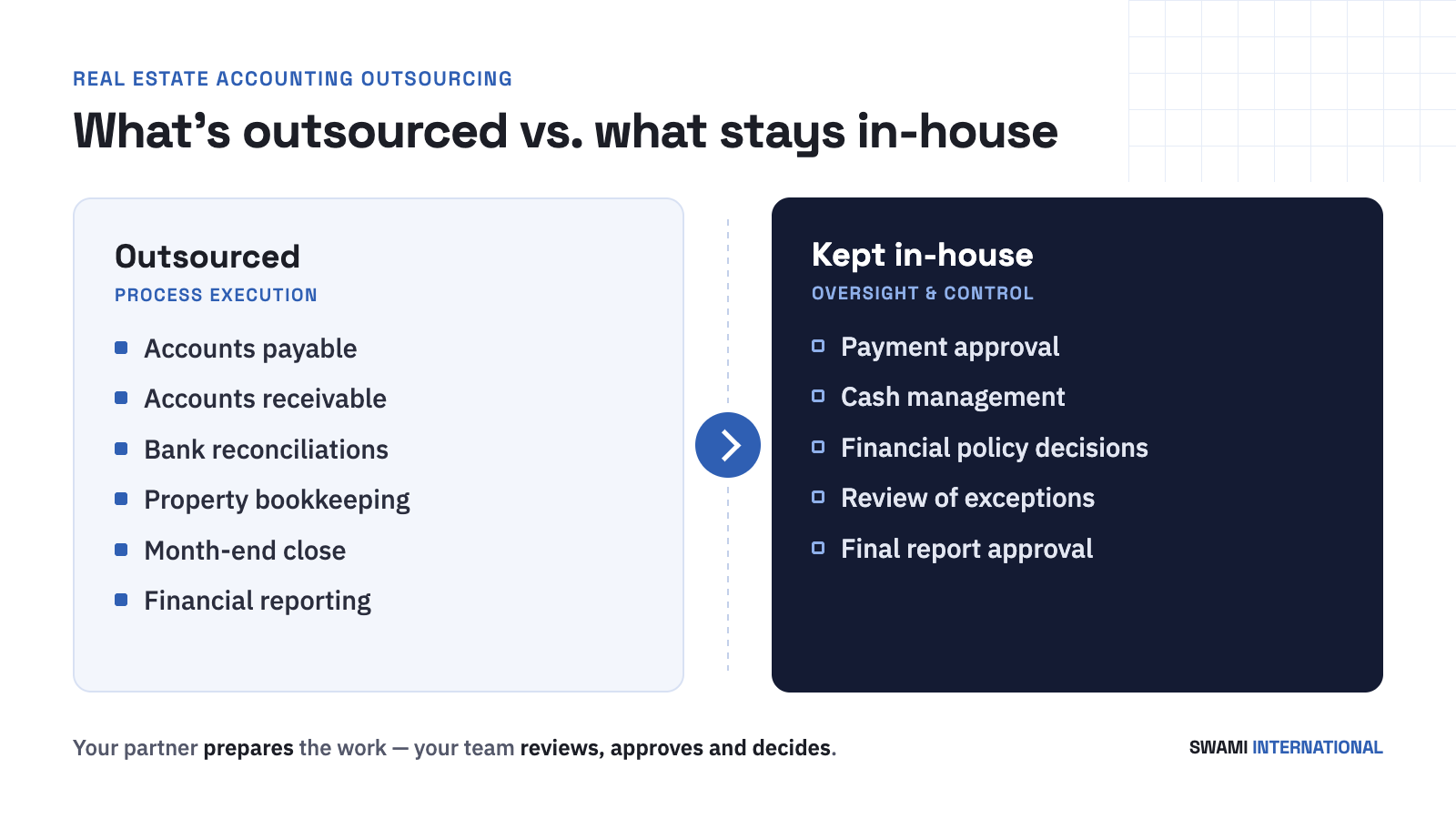
Not every accounting responsibility needs to be handled internally. Many recurring and process-driven accounting activities can be supported by an external team, provided the responsibilities, approval limits and review procedures are clearly defined. Common outsourcing opportunities include:

Accounts payable support

  • Invoice entry and coding
  • Vendor record maintenance
  • Invoice documentation
  • Payment schedule preparation
  • Accounts payable reconciliations
  • Outstanding invoice reporting

Stays internal: payment authorization and release, under the company’s established approval controls.

Accounts receivable support

  • Recording receipts
  • Maintaining receivable records
  • Applying payments
  • Reviewing outstanding balances
  • Preparing receivable reports
  • Identifying discrepancies for internal follow-up

Stays internal: tenant communication, collections decisions and legal enforcement, handled by appropriately authorized personnel.

Bank & general ledger reconciliations

  • Bank reconciliations
  • Credit card reconciliations
  • Balance sheet reconciliations
  • Intercompany reconciliations
  • General ledger reviews
  • Reconciliation documentation

Stays internal: review of unresolved differences — they should be escalated rather than automatically adjusted.

Property bookkeeping

  • Transaction recording
  • Expense classification
  • Income recording
  • Journal entry preparation
  • Supporting schedule maintenance
  • General ledger updates

Month-end close support

  • Transaction cutoff preparation
  • Account reconciliations
  • Accrual preparation
  • Journal entry support
  • General ledger reviews
  • Financial report preparation
  • Close checklist maintenance

Stays internal: review and approval of the final close by the Controller or designated internal reviewer.

Financial reporting support

  • Property-level income statements
  • Balance sheet schedules
  • Cash flow reporting
  • Budget-versus-actual reports
  • Portfolio-level reporting support
  • Owner statement preparation
  • Supporting schedules for management review

Stays internal: the reporting structure, which should reflect the company’s accounting policies and the needs of its owners and stakeholders.

Depending on the company’s systems, operating model and agreed scope, the exact services within each area will vary.

What Should a Property Management Company Keep In-House?

Outsourcing accounting does not mean transferring complete financial responsibility to an external provider. The company should retain ownership of important financial decisions, policies and controls.

ResponsibilityRecommended ownership
Accounting policies and proceduresInternal management
Financial strategy and planningInternal management
Budget approvalInternal management
Payment authorizationAuthorized internal personnel
Bank account ownership and controlInternal management
Final financial statement reviewInternal Controller or designated reviewer
Accounting transaction processingInternal team or outsourced provider
Reconciliation preparationInternal team or outsourced provider
Month-end close supportInternal team or outsourced provider
Financial reporting preparationInternal team or outsourced provider
Final management decisionsInternal management

The exact division of responsibilities depends on the company’s structure, service agreement, software environment and internal control requirements.

A well-designed outsourcing arrangement separates preparation from approval wherever practical.

For example, an external accounting team may prepare a bank reconciliation, but an authorized internal reviewer should investigate material exceptions and approve the reconciliation.

  1. Provider prepares
  2. Internal reviewer investigates exceptions
  1. Internal approval

This approach allows a company to increase accounting capacity while retaining control over its financial operations.

When Is a Property Management Company Not Ready to Outsource?

Outsourcing is not a substitute for basic accounting discipline. A company may need to address certain internal issues before transferring accounting responsibilities to an external team. Consider delaying the transition until the following areas are understood:

Readiness gapUnclear accounting procedures

If nobody can explain how transactions are recorded, reviewed and approved, the provider may struggle to deliver consistent results.

Readiness gapInconsistent financial records

Incomplete records, unresolved historical balances and unreliable supporting documentation can complicate the transition.

Readiness gapUnclear ownership of responsibilities

The company should know who prepares, reviews, approves and escalates each accounting activity.

Readiness gapUncontrolled system access

Access permissions should be defined before an external provider is given access to financial systems.

Readiness gapUnrealistic expectations

Outsourcing cannot automatically fix inaccurate source data, poor property-level processes or missing documentation.

A successful transition requires cooperation between the property management company and the accounting provider.

In some situations, the first step should be a process review and cleanup rather than immediately outsourcing the entire accounting function.

How to Evaluate Whether Outsourcing Makes Financial Sense

The decision should consider more than the quoted outsourcing fee. A company should compare the total cost and operational impact of its current accounting arrangement with the proposed outsourced model.

Current in-house costs

  • Salaries and benefits
  • Recruitment and onboarding
  • Employee training
  • Accounting software and technology
  • Overtime and temporary staffing
  • Management time spent supervising routine work
  • Costs associated with turnover and vacancies

Expected outsourcing costs

  • Monthly service fees
  • One-time onboarding or transition costs
  • Additional fees for services outside the agreed scope
  • Software and integration costs
  • Internal time required for coordination and review
  • Costs associated with additional reporting requirements

Compare operational benefits

Financial cost is only one part of the decision. Also consider whether the outsourced model can improve:

  • Accounting task completion
  • Reconciliation consistency
  • Month-end close coordination
  • Reporting timelines
  • Process documentation
  • Staff workload
  • Capacity to support portfolio growth

The most suitable option is the one that provides reliable accounting support, appropriate financial controls and a sustainable operating model.

A Practical Checklist: Is It Time to Outsource Your Accounting?

Use the following checklist to evaluate your current accounting setup.

Is it time to outsource?

  • Month-end close is regularly delayed
  • Bank and balance sheet reconciliations are falling behind
  • The accounting workload has increased faster than staffing capacity
  • Financial reports are inconsistent or difficult to prepare
  • Senior finance employees spend too much time on routine tasks
  • Accounting processes depend heavily on one or two employees
  • Recruiting and retaining accounting staff is becoming difficult
  • The company needs additional accounting capacity without significantly expanding its internal team
  • Accounting procedures and approval responsibilities can be documented
  • Management is prepared to establish clear oversight of an external provider

If several of these issues apply, it may be worth evaluating an outsourced accounting arrangement.

However, the number of checked items should not be treated as a formal threshold. The seriousness, frequency and financial impact of the problems matter more than the count.

How to Start Outsourcing Accounting Without Disrupting Operations

Once a company decides to explore outsourcing, the transition should be planned carefully. A phased approach is often more practical than transferring every accounting responsibility at once.

Step 1Review your existing accounting processes

Document the current accounting workflow, including transaction processing, reconciliations, reporting, approvals and month-end responsibilities. Identify bottlenecks, recurring errors and tasks that consume the most internal resources.

Step 2Define the scope of outsourcing

Decide which responsibilities should be handled externally. For example, a company may initially outsource bank reconciliations, accounts payable support and month-end close preparation while retaining payment approvals and financial review internally.

Step 3Select the right accounting partner

Evaluate providers based on:

  • Experience with real estate and property management accounting
  • Familiarity with your accounting software
  • Understanding of multi-property and multi-entity structures
  • Documented processes and quality controls
  • Data security and access management
  • Communication and reporting procedures
  • Ability to scale with your portfolio

Step 4Establish access and internal controls

Set up appropriate user permissions, approval limits, documentation requirements and escalation procedures. External personnel should receive only the access required to perform their assigned responsibilities.

Step 5Begin with a defined transition period

Start with an agreed group of properties, accounting tasks or reporting activities. Review the work regularly, resolve process gaps and confirm that responsibilities are being completed as expected.

Step 6Monitor performance

Establish measurable service expectations, such as:

  • Completion of assigned reconciliations
  • Accounting task turnaround times
  • Month-end close milestones
  • Accuracy and completeness of documentation
  • Timely escalation of discrepancies
  • Reporting preparation deadlines

Review performance periodically and adjust the scope as the business evolves.

Should You Outsource All Accounting or Only Selected Functions?

A property management company does not necessarily need to outsource its entire accounting department. The right model depends on its internal capabilities and operational requirements.

Partial outsourcing

The company retains its Controller and core accounting team but delegates selected recurring tasks such as reconciliations, accounts payable processing, bookkeeping or reporting preparation.

Works well when strong internal financial leadership exists but more execution capacity is needed.

Full outsourcing

A broader range of accounting operations moves to an external provider, while internal oversight, approvals and financial decision-making are retained.

May suit businesses that do not want to maintain a large internal accounting department.

Hybrid model

Internal finance leadership manages oversight, planning, approvals and business decisions; the external team supports recurring accounting processes and reporting.

Combines internal control with additional operational capacity.

For many growing property management companies, a hybrid arrangement is worth evaluating because it combines internal control with additional operational capacity. For a broader comparison, see our guide to real estate accounting outsourcing and our complete guide to property management accounting.

How Swami International Back Office Services Supports Property Management Companies

Swami International Back Office Services provides back-office support for U.S.-based property management companies and real estate businesses.

Our services are designed to help businesses manage recurring accounting and operational responsibilities while allowing internal management teams to focus on oversight, portfolio performance and business growth. Depending on the company’s requirements, support can include:

  • Property management accounting support
  • Bookkeeping and transaction processing
  • Accounts payable and receivable support
  • Bank and account reconciliations
  • Month-end close assistance
  • Financial reporting support
  • Real estate partnership tax support
  • Financial spreading and loan sizing

The appropriate service scope depends on the client’s portfolio, existing accounting structure, software environment and internal control requirements.

Whether a company needs assistance with selected accounting tasks or broader back-office support, the first step is understanding its existing processes and identifying where additional capacity would be most useful.

Frequently Asked Questions

When should a property management company outsource its accounting?

A property management company should consider outsourcing when its accounting workload exceeds the capacity of its internal team, month-end close is consistently delayed, reconciliations fall behind, reporting becomes inconsistent or senior finance employees spend too much time on routine tasks.

How many properties should a company manage before outsourcing accounting?

There is no fixed property or unit count that determines when outsourcing becomes necessary. The decision depends on transaction volume, portfolio complexity, ownership structures, reporting requirements, staffing capacity and the efficiency of existing processes.

Can a small property management company outsource accounting?

Yes. Smaller property management companies can outsource selected accounting responsibilities, such as bookkeeping, accounts payable processing, bank reconciliations and month-end close support. This can provide additional capacity without requiring a full internal accounting department.

Is it better to outsource all accounting or only certain tasks?

It depends on the company’s internal capabilities. Some businesses outsource selected recurring tasks while retaining an internal Controller. Others use a broader outsourced model with internal management retaining financial oversight and approval authority.

Does outsourcing accounting mean losing financial control?

No. A properly structured outsourcing arrangement should preserve internal control through defined access permissions, approval limits, documented procedures, independent reviews and clear responsibility assignments.

What accounting tasks can property management companies outsource?

Commonly outsourced tasks include bookkeeping, accounts payable and receivable support, bank reconciliations, general ledger maintenance, month-end close assistance and financial report preparation. The final scope depends on the service agreement and the company’s internal controls.

Can an outsourced accounting team work with our existing property management software?

Many outsourced accounting arrangements can operate within a client’s existing software environment, provided the provider has the necessary platform knowledge, permissions and access. The software setup and integration requirements should be evaluated before the engagement begins.

How do we transition accounting responsibilities to an outsourced provider?

A transition typically involves reviewing existing processes, defining the scope of work, documenting procedures, establishing system access and approval controls, transferring relevant records and starting with a structured onboarding period. A phased transition can help reduce disruption.

Conclusion

Outsourcing accounting can be a practical option when a property management company’s existing accounting structure can no longer keep pace with its operational needs.

Delayed reconciliations, inconsistent reporting, an overloaded accounting team and growing dependence on individual employees are all reasons to review the current model.

However, the decision should not be based on portfolio size alone. Companies should evaluate their processes, staffing capacity, financial controls and long-term operating requirements before deciding which responsibilities to outsource.

With a clearly defined scope, appropriate oversight and a reliable accounting partner, property management companies can build a more scalable back-office structure while retaining control over important financial decisions.

Explore Swami International Back Office Services

Learn more about our property management back-office support and accounting solutions — from selected recurring tasks to broader back-office support, scoped around your portfolio, software and internal controls.

Disclaimer: This article provides general business and operational information and should not be considered legal, tax or accounting advice. Outsourcing arrangements should be evaluated based on each company’s circumstances, applicable requirements and internal control policies.

Property Management Accounting: A Complete Guide to Managing Property Finances

A practical guide to property management accounting: chart of accounts, tenant accounting, AP/AR, security deposits, reconciliation, owner reporting and month-end close.

Property manager reviewing rental income and owner statements
Property Management Accounting

Property Management Accounting: A Complete Guide to Managing Property Finances

Managing rental properties involves far more than collecting rent and coordinating maintenance. Property management companies must keep financial records accurate, track income and expenses across multiple properties, process tenant payments, pay vendors, maintain owner balances, and produce reliable financial reports.

As a property portfolio grows, these responsibilities become increasingly complex. A company managing several properties may be able to oversee its finances with a relatively simple accounting process. However, managing dozens or hundreds of properties introduces more transactions, additional reporting requirements, multiple ownership structures, and a greater need for standardized financial controls.

Property management accounting provides the financial framework for managing these responsibilities efficiently. It helps property managers understand how each property performs, maintain accurate financial records, monitor cash flow, and give property owners a clear picture of their investments.

This guide explains how property management accounting works, the essential processes every property management company should establish, the reports that support better decisions, and how to build an accounting workflow that can scale with a growing portfolio.

What Is Property Management Accounting?

Property management accounting is the process of recording, organizing, reconciling, and reporting the financial transactions associated with managing real estate properties on behalf of owners or ownership entities.

Unlike accounting for a conventional business, property management accounting must often track financial activity at several levels simultaneously:

  1. Transaction
  2. Tenant
  3. Unit
  4. Property
  5. Owner
  6. Management company

Common activities include:

  • Recording rental income and other property-related revenue
  • Maintaining tenant ledgers and accounts receivable
  • Processing vendor invoices and accounts payable
  • Tracking property operating expenses
  • Recording management fees and other authorized charges
  • Reconciling bank accounts
  • Tracking security deposits and other liabilities
  • Monitoring owner balances and distributions
  • Preparing property-level income statements
  • Producing monthly owner statements
  • Supporting month-end and year-end close
  • Maintaining records for tax preparation and financial reviews

The exact responsibilities depend on the management agreement, property type, ownership structure, accounting method, and applicable legal requirements.

Residential property manager

May need to track rent, security deposits, repairs, and owner distributions.

Commercial property manager

May also handle CAM reconciliations, tenant reimbursements, operating expense recoveries, and more complex lease-related calculations.

In both cases, the objective is the same: to maintain accurate financial records that reflect what happened financially, which property it relates to, and who is entitled or obligated to the resulting balance.

Why Is Property Management Accounting Important?

A reliable accounting system helps property management companies move beyond simply recording transactions. It gives management the information needed to oversee properties, communicate with owners, identify financial problems, and operate consistently.

01Provides visibility into property performance

Portfolio-wide financial totals do not always reveal what is happening at individual properties. One property may generate strong operating income while another experiences rising maintenance expenses, extended vacancies, or declining rental collections.

Property-level accounting makes it easier to identify these differences and investigate the reasons behind them.

02Improves cash flow management

Property managers must understand not only how much income a property generates but also when money is collected, which bills are due, and how much cash is available for authorized payments and distributions.

Accurate records help management anticipate upcoming obligations and avoid making decisions based on incomplete balances.

03Strengthens owner relationships

Property owners expect transparent reporting about their investments. When income, expenses, fees, reserves, and distributions are documented clearly, owners can better understand the financial performance of their properties.

Consistent reporting also reduces the time spent answering questions about unexplained charges or discrepancies.

04Supports financial controls and compliance

Property managers may handle funds belonging to owners or tenants. Depending on the jurisdiction, specific rules may govern the handling, accounting, reconciliation, and reporting of those funds.

A documented accounting process helps establish accountability, maintain supporting records, and identify discrepancies promptly.

05Supports portfolio growth

Manual processes that work for a small portfolio may become difficult to maintain as transaction volumes increase.

Standardized accounting procedures, consistent account coding, defined approval responsibilities, and reliable reporting workflows help companies expand without allowing administrative work to grow uncontrollably.

How Is Property Management Accounting Different From General Accounting?

Property management accounting follows many of the same principles as general business accounting, but it requires additional property-specific tracking and controls.

Accounting areaProperty management requirement
Income trackingRecord rent and other income by the relevant property, tenant, or ownership entity.
Expense managementAssign expenses to the correct property and accounting category.
Accounts receivableMonitor tenant balances, overdue rent, and other amounts owed.
Accounts payableProcess vendor invoices with appropriate property coding and approvals.
Cash managementReconcile bank activity and distinguish company funds from funds held for others.
Liability trackingMaintain accurate records of security deposits, owner balances, and other obligations.
Financial reportingProduce property-level reports and owner statements.
Portfolio oversightConsolidate financial information where appropriate without losing property-level detail.

The distinction becomes especially important when a property management company manages properties owned by different individuals, partnerships, or legal entities.

The accounting structure must preserve the separation between those interests and the management company’s own financial activity.

The Core Components of Property Management Accounting

01Chart of Accounts and Accounting Structure

The chart of accounts is the foundation of the accounting system. It defines how financial transactions are categorized and how information appears in financial reports. A typical property management chart of accounts may include the following categories.

Assets

  • Cash and bank accounts
  • Accounts receivable
  • Prepaid expenses
  • Property-related assets
  • Other receivables

Liabilities

  • Accounts payable
  • Security deposits payable
  • Owner funds payable
  • Accrued expenses
  • Loans and other obligations

Equity

  • Owner equity
  • Capital contributions
  • Retained earnings
  • Distributions, where appropriate to the entity’s accounting structure

Income

  • Rental income
  • Parking income
  • Laundry income
  • Late fees and other tenant charges
  • Utility reimbursements
  • Management fees earned by the management company

Expenses

  • Repairs and maintenance
  • Utilities
  • Insurance
  • Property taxes
  • Landscaping and cleaning
  • Advertising and leasing
  • Professional services
  • Management and administrative expenses

The specific accounts will vary depending on whether the records belong to the property owner, an ownership entity, or the management company.

A well-designed accounting structure should provide enough detail to support reporting and analysis without creating an unnecessarily complicated bookkeeping process.

02Rental Income and Tenant Accounting

Rental income is one of the primary financial activities associated with property management. The accounting process should connect the lease terms, tenant ledger, payment records, and accounting entries.

  1. Lease terms
  2. Tenant ledger
  3. Payment records
  4. Accounting entries

Depending on the property, transactions may include:

  • Monthly rent
  • Parking charges
  • Utility reimbursements
  • Late fees
  • Other authorized tenant charges
  • Credits and adjustments
  • Refunds and reversals

Property managers should establish a process for identifying payments, applying them to the correct tenant account, and investigating differences between expected and actual collections.

For example, if a property has 40 occupied units, the accounting team should be able to determine:

  • How much rent was billed?
  • How much was collected?
  • Which tenant balances remain outstanding?
  • Does recorded income agree with the underlying records?

Accurate tenant accounting helps prevent payment misapplication, unexplained balances, and unreliable rental income reporting.

It is also important to distinguish rent billed from cash collected. These amounts may differ because of outstanding balances, payment timing, credits, or the accounting method being used.

03Accounts Receivable Management

Accounts receivable represents amounts owed to a property, owner, or management company. In property management, receivables may include unpaid rent, tenant charges, utility reimbursements, and other amounts that have been billed but not collected.

An effective accounts receivable process should include:

  1. Recording charges accurately
  2. Applying payments to the appropriate accounts
  3. Reconciling tenant ledgers
  4. Reviewing overdue balances
  5. Investigating disputed or incorrect charges
  6. Providing aging reports to the relevant team
  7. Documenting collection activity and adjustments

An accounts receivable aging report groups outstanding balances according to how long they have remained unpaid. This helps management identify accounts that require attention.

Property managers should also establish clear procedures for credits, write-offs, payment reversals, and adjustments so that changes are authorized and documented.

04Accounts Payable and Vendor Payments

Property management companies regularly receive invoices for maintenance, repairs, utilities, landscaping, cleaning, insurance, and other services.

Without a standardized accounts payable process, invoices can be duplicated, incorrectly coded, paid late, or charged to the wrong property.

A controlled AP workflow generally includes:

  1. Receive and record invoice
  2. Identify property and vendor
  3. Check supporting documentation
  4. Assign expense category
  5. Obtain approvals
  6. Schedule and process payment
  7. Record payment
  8. Reconcile

For example, a $750 plumbing invoice should be associated with the correct property, coded to the appropriate expense account, supported by the relevant invoice, and approved according to the company’s procedures.

If the same vendor serves multiple properties, the accounting process should also prevent costs from being assigned to the wrong owner or property.

05Property Expenses and Capital Expenditures

Tracking expenses accurately is essential for understanding property performance.

Operating expenses

Routine repairs, landscaping, cleaning, utilities, insurance, and property management fees. e.g. repairing a leaking faucet

Capital expenditures

Certain improvements or replacements may need to be recorded as assets and depreciated rather than expensed immediately. e.g. replacing a building’s plumbing system

The appropriate treatment depends on the nature of the work and applicable accounting and tax rules.

Property managers should establish a consistent review process for significant expenditures and retain supporting documentation. The accounting team should not automatically classify every large invoice as a capital expenditure—or every repair-related invoice as an immediate expense—without considering the relevant facts and rules.

Consistent classification improves the reliability of property-level financial reports and supports tax preparation.

06Security Deposit Accounting

Security deposits require careful tracking because they generally represent amounts held subject to the terms of the tenancy and applicable law, rather than ordinary rental revenue.

A property management accounting process should record:

  • The amount received
  • The tenant and unit associated with the deposit
  • The date received
  • The applicable liability balance
  • Any authorized deductions or adjustments
  • The amount returned
  • The remaining balance, if any

Security deposit records should be reconciled with the relevant accounting balances and bank records as required by applicable law and company procedures.

Property managers should also follow jurisdiction-specific requirements governing deposit handling, permissible deductions, notices, and refunds.

07Bank Reconciliation and Cash Management

Bank reconciliation compares accounting records with bank statements to confirm that transactions and balances agree. It helps identify missing entries, duplicate transactions, bank fees, outstanding payments, deposits in transit, and other differences.

Property management companies may need to reconcile several types of accounts, depending on their operations and legal structure. A consistent reconciliation process should establish:

  • Who prepares each reconciliation
  • How frequently it is completed
  • Who reviews it
  • How discrepancies are investigated
  • How adjustments are documented
  • How outstanding items are tracked until resolved

Cash management also requires a clear understanding of which funds are available for which purposes.

A bank balance alone does not necessarily indicate how much cash is available for owner distributions. Some funds may be associated with security deposits, owner obligations, reserves, outstanding payments, or other restrictions.

Reconciled records and accurate liability tracking are essential for determining available cash responsibly.

08Owner Accounting and Distributions

Owner accounting connects property financial activity with the amounts attributable to each property owner. Depending on the management agreement and reporting format, an owner statement may include:

  • Beginning balance
  • Rental income
  • Other property income
  • Operating expenses
  • Management fees
  • Capital expenditures
  • Owner contributions
  • Reserve activity
  • Owner distributions
  • Ending balance

For example, a property may collect $25,000 in rent during a month but have $8,000 in expenses and other authorized deductions. The amount available for distribution will depend on the full accounting position, including reserves, outstanding obligations, and the management agreement.

Example monthAmount
Rent collected$25,000
Expenses and authorized deductions−$8,000
Available for distributionDepends on reserves, outstanding obligations, and the management agreement

The accounting team should ensure that owner statements are supported by the underlying transaction records and reconciled balances.

Owner reporting should also distinguish the financial performance of the property from the revenue and expenses of the property management company itself.

Essential Financial Reports for Property Management Companies

Financial reports help property managers turn transaction records into actionable information. The most useful reports depend on the company’s portfolio, ownership structure, and reporting requirements.

Property-Level P&L

Summarizes income and expenses for an individual property over a period. Comparing months can highlight changes in expenses, vacancy-related effects, and other trends.

Balance Sheet

Summarizes assets, liabilities, and equity at a particular date — cash, receivables, payables, deposits, and owner balances. Key for checking that liabilities are supported by records.

Cash Flow Report

Shows the movement of cash during a period. Cash flow should not be confused with accounting profit or with the amount immediately available for distribution.

Rent Roll

Summarizes tenants, contracted rent, occupancy, and lease terms at the unit or lease level. An operational report — not a substitute for a financial statement — and should be reconciled with accounting records.

AR Aging Report

Shows outstanding balances grouped by age, helping identify overdue accounts, investigate discrepancies, and prioritize collection activity.

AP Aging Report

Summarizes unpaid vendor invoices by due date or aging category. Supports payment planning and visibility into upcoming cash requirements.

Owner Statement

Summarizes financial activity and balances attributable to an owner or property — income, expenses, fees, reserve activity, and distributions — in a clear, consistent format.

The Property Management Accounting Cycle

A standardized accounting cycle helps ensure that transactions are recorded, reviewed, reconciled, and reported consistently.

  1. Capture financial transactionsCollect invoices, tenant payments, bank transactions, receipts, and other supporting documents.
  2. Classify transactionsAssign the correct account, property, ownership entity, and other required tracking information.
  3. Review and approveFollow the company’s authorization procedures for invoices, payments, adjustments, and other transactions.
  4. Record transactionsPost approved transactions to the accounting system and update relevant ledgers.
  5. Reconcile accountsCompare accounting records with bank statements, tenant ledgers, vendor balances, and other supporting records as appropriate.
  6. Investigate exceptionsResolve discrepancies, missing documentation, unusual transactions, and unexplained balances.
  7. Prepare financial reportsGenerate property-level financial statements, aging reports, owner statements, and other required reports.
  8. Review and finalize the periodComplete the month-end review, record necessary adjustments, and apply appropriate controls to the closed reporting period.

Repeating this cycle consistently helps property managers maintain reliable records and identify issues before they accumulate.

Month-End Close for Property Management Companies

Month-end close is one of the most important recurring accounting processes. A structured close helps ensure that financial reports reflect the activity of the period and that important balances have been reviewed.

A typical month-end process includes:

Month-end close checklist

  • Confirm that rent and other income have been recorded
  • Review tenant receivables and outstanding balances
  • Record vendor invoices and review accounts payable
  • Reconcile bank accounts
  • Review security deposits and other liabilities
  • Investigate unusual expenses and significant variances
  • Review owner balances and reserve activity
  • Record accruals, prepaid expenses, depreciation, or other adjustments where applicable
  • Review property-level profit and loss statements and balance sheets
  • Finalize owner reporting and document unresolved items

The exact steps will depend on the accounting method and reporting requirements.

A documented close checklist helps standardize responsibilities, reduce missed tasks, and make it easier to identify bottlenecks as transaction volumes grow.

Common Property Management Accounting Challenges

Even companies with established accounting systems can experience problems when processes are inconsistent or responsibilities are unclear.

Challenge 1Inconsistent transaction coding

When similar expenses are assigned to different accounts across properties, financial comparisons become less reliable.

Improvement: Establish clear account definitions and coding guidelines.

Challenge 2Delayed bank reconciliations

When reconciliations are postponed, discrepancies can become harder to investigate.

Improvement: Assign responsibility, establish deadlines, and track unresolved items.

Challenge 3Inaccurate tenant balances

Payments may be misapplied, charges duplicated, or credits recorded incorrectly.

Improvement: Reconcile tenant ledgers regularly and document adjustments.

Challenge 4Unclear owner balances

Poor tracking of income, expenses, reserves, and distributions can lead to unexplained owner statement balances.

Improvement: Maintain property-level records and reconcile owner-related balances as part of the regular close.

Challenge 5Excessive manual work

Repeated spreadsheet updates and disconnected systems can lead to duplicate entry, inconsistent records, and delays.

Improvement: Standardize workflows and evaluate appropriate software integrations or automation.

Challenge 6Incomplete documentation

Missing invoices, approvals, receipts, or supporting records make transactions harder to verify.

Improvement: Establish document-retention standards and consistent procedures for attaching or storing supporting documentation.

Challenge 7Difficulty scaling the accounting function

A process that works for ten properties may not work efficiently for a portfolio of several hundred.

Improvement: Document standard operating procedures, define responsibilities, monitor workload, and build repeatable accounting workflows.

How Technology Supports Property Management Accounting

Property management and accounting software can help centralize financial information and reduce repetitive work. Depending on the system, features may support:

  • Rent collection and tenant ledgers
  • Invoice processing
  • Accounts payable and receivable
  • Bank feeds and reconciliation
  • Property-level financial reporting
  • Owner statements
  • Document management
  • Workflow approvals
  • Data exports and integrations

However, software alone does not guarantee accurate accounting. Incorrect account mappings, incomplete transaction data, inconsistent coding, and insufficient review can still create reporting problems.

Before adopting a new platform or automating a process, property management companies should define the information they need, the controls they must maintain, and the reports they expect to produce.

Technology should support a well-designed accounting workflow rather than compensate for an unclear one.

Should Property Management Companies Outsource Accounting?

As a property portfolio expands, internal teams may find it increasingly difficult to keep up with transaction processing, reconciliations, reporting, and month-end close.

Accounting outsourcing can provide additional capacity and access to specialized accounting support without requiring every task to be handled by an internal employee. A property management company may consider outsourcing when:

  • Transaction volumes have increased significantly
  • Month-end close regularly falls behind schedule
  • Owner reporting requires extensive manual effort
  • AP or AR processes have become difficult to manage
  • Reconciliations are delayed
  • Internal staff spend too much time on repetitive accounting tasks
  • The business needs standardized procedures across multiple properties
  • Management wants to scale without expanding internal accounting resources at the same rate

Outsourced team may assist with

  • Transaction recording
  • AP and AR
  • Reconciliations
  • Financial reporting
  • Month-end close

Your company generally retains

  • Operational decisions
  • Approvals
  • Oversight
  • Assigned compliance obligations

Responsibilities should be clearly documented in the service agreement and operating procedures.

Before choosing an outsourcing provider, businesses should assess relevant real estate accounting experience, data-security practices, software compatibility, reporting processes, communication standards, and the provider’s ability to work within the company’s controls. For a deeper look, read our guide to real estate accounting outsourcing.

Outsourcing is not simply about transferring tasks. It is about establishing a reliable process with clear accountability.

Best Practices for Building a Scalable Property Management Accounting System

Property management companies can strengthen their accounting operations by following a consistent set of practices.

01Standardize the chart of accounts

Use consistent categories and coding guidelines across comparable properties.

02Maintain property-level detail

Ensure transactions can be traced to the appropriate property, ownership entity, and accounting category.

03Separate financial responsibilities

Maintain appropriate distinctions between management-company funds and funds held or managed for others.

04Reconcile accounts regularly

Review bank accounts, tenant balances, vendor balances, and relevant liabilities according to established procedures.

05Document approval workflows

Define who can approve invoices, process payments, authorize adjustments, and review reconciliations.

06Create a month-end close checklist

Assign responsibilities and deadlines for recurring accounting tasks.

07Review financial variances

Investigate significant changes in income, expenses, receivables, and cash balances.

08Use technology appropriately

Reduce unnecessary manual work while maintaining controls and human review where needed.

09Monitor performance

Track measures such as close completion time, unreconciled items, overdue receivables, invoice-processing time, and reporting accuracy.

10Review procedures as the portfolio grows

Update processes when new properties, ownership structures, systems, or reporting requirements are introduced.

Frequently Asked Questions About Property Management Accounting

What does property management accounting include?

Property management accounting typically includes rental income tracking, tenant accounting, accounts payable, accounts receivable, expense classification, bank reconciliation, security deposit accounting, owner reporting, financial statement preparation, and month-end close.

What is the difference between property management accounting and bookkeeping?

Bookkeeping primarily focuses on recording and classifying financial transactions. Property management accounting includes bookkeeping but also involves reconciliations, financial reporting, balance review, accounting controls, and analysis of property-level financial information.

What financial reports should a property management company prepare?

Common reports include property-level profit and loss statements, balance sheets, cash flow reports, rent rolls, accounts receivable aging, accounts payable aging, and owner statements. The appropriate reports depend on the company’s operations and reporting obligations.

Why is property-level accounting important?

Property-level accounting makes it possible to evaluate each property’s income, expenses, and financial performance separately. It also helps property managers allocate costs correctly, prepare owner statements, and identify unusual financial trends.

Can property management accounting be outsourced?

Yes. Depending on the provider and agreement, property management companies can outsource activities such as bookkeeping, AP and AR, bank reconciliation, financial reporting, and month-end close support. The company should establish clear responsibilities, approval controls, data-security requirements, and reporting expectations.

How often should property management accounts be reconciled?

Bank accounts and other material balances should be reconciled at an appropriate frequency under the company’s procedures and applicable requirements. Monthly reconciliation is a common minimum for routine financial close processes, while certain accounts or regulated activities may require more frequent attention.

What is the most important part of property management accounting?

There is no single task that guarantees reliable accounting. The most important foundation is a consistent system that combines accurate transaction records, property-level tracking, appropriate financial controls, regular reconciliations, and clear reporting.

Conclusion

Property management accounting is essential for maintaining accurate financial records, understanding property performance, managing cash flow, and providing transparent reporting to property owners.

A reliable system connects tenant transactions, vendor payments, expenses, bank reconciliations, owner balances, and financial reports through a standardized process. As portfolios grow, documented procedures, appropriate technology, and clear accountability become increasingly important.

For property management companies, the objective is not simply to keep the books updated. It is to create a financial operation that supports day-to-day property management while providing the reliable information needed to make informed business decisions.

Accurate property management accounting helps turn complex financial activity into clear, actionable information—one property, one transaction, and one reporting period at a time.

Swami Back Office Services

We support real estate businesses with accounting and back-office processes designed to help maintain organized financial records and consistent workflows. For companies reviewing their current accounting operations, establishing a structured process for AP, AR, reconciliations, month-end close, and owner reporting is a practical starting point.

Disclaimer: This article is for general educational purposes and does not constitute accounting, tax, or legal advice. Requirements vary by property type, ownership structure, and jurisdiction. Consult an appropriately qualified professional about your specific circumstances.

Real Estate Accounting: A Complete Guide for Property Management Companies

Learn how real estate accounting works for property management companies, including property accounting, AP, AR, reconciliations, reporting, and month-end close.

Property management accountant reviewing property-level financial statements
Real Estate Accounting

Real Estate Accounting: A Complete Guide for Property Management Companies

Managing real estate is about much more than collecting rent and paying bills. For property management companies, accurate accounting is the foundation for understanding property performance, maintaining accurate owner records, managing cash flow, preparing financial reports, and supporting tax and compliance requirements.

As a property portfolio grows, accounting becomes increasingly complex. A property manager may need to track income and expenses across multiple properties, owners, units, bank accounts, vendors, tenants, and legal entities—all while keeping the management company's finances separate from funds held or managed on behalf of property owners and residents.

That is why real estate accounting requires a system designed around the way real estate businesses actually operate.

This guide explains the fundamentals of real estate accounting, the major accounting functions property management companies need, the reports they should produce, common challenges, and how to build an accounting process that can scale with a growing portfolio.

What Is Real Estate Accounting?

Real estate accounting is the process of recording, organizing, reconciling, analyzing, and reporting the financial activity associated with real estate properties and businesses.

For a property management company, this can include:

  • Rental income
  • Management fees
  • Late fees and other property income
  • Property operating expenses
  • Repairs and maintenance
  • Utilities
  • Insurance
  • Property taxes
  • Vendor invoices
  • Security deposits
  • Owner contributions and distributions
  • Capital expenditures
  • Mortgage and financing activity
  • Accounts payable and accounts receivable
  • Bank and account reconciliations
  • Property-level financial reporting

The exact accounting requirements depend on the type of property, ownership structure, services provided, accounting method, and applicable jurisdiction.

The IRS notes that rental records should support income and expenses, financial statements, and tax reporting. For rental property owners, common rental expenses can include items such as maintenance, insurance, taxes, interest, utilities, management fees, and depreciation, subject to applicable tax rules.

For property management companies, however, accounting goes beyond simply recording rental income and expenses. The accounting system also needs to answer an important question:

Whose money is it?

A property management company may handle money belonging to property owners or tenants. Those funds need to be tracked separately and accurately from the management company's own operating finances. The specific trust-account requirements vary by jurisdiction and business structure, so property managers should follow applicable state and local requirements and obtain professional advice where necessary.

Why Is Real Estate Accounting Different?

Real estate accounting shares many fundamentals with other forms of business accounting, but property management introduces additional layers of complexity.

A conventional business might have one operating entity, one primary bank account, and one set of financial statements. A property management company may instead manage:

  • Multiple properties
  • Multiple owners
  • Multiple ownership entities
  • Hundreds or thousands of tenants
  • Multiple bank accounts
  • Security deposits
  • Owner reserves
  • Vendor relationships
  • Property-level income and expenses
  • Management-company revenue
  • Intercompany transactions

The accounting system therefore needs to maintain both property-level detail and portfolio-level visibility.

For example, if a plumbing repair costs $1,200, it isn't enough to record a $1,200 expense. The accounting records should allow the business to determine:

  • Which property incurred the expense?
  • Which unit was affected?
  • Which vendor was paid?
  • Was the expense an operating repair or a capital improvement?
  • Was it paid from the correct account?
  • Does the owner need to see it on their statement?
  • Does the expense affect a reserve?
  • Has the invoice been paid?
  • Does the transaction reconcile to the bank?

This property-level detail is one of the defining characteristics of effective real estate accounting.

The Core Components of Real Estate Accounting

A strong real estate accounting system typically brings together several interconnected functions.

01Property-Level Accounting

Property-level accounting tracks financial activity separately for each property. This is essential because portfolio-level totals can hide the performance of individual properties.

For example, a portfolio may generate a positive overall cash flow while one property consistently produces losses because of:

  • High maintenance costs
  • Excessive vacancy
  • Rising utilities
  • Insurance increases
  • Property tax changes
  • Unplanned capital expenditures

Property-level accounting makes those differences visible. A well-structured system should allow management to move from:

  1. Portfolio
  2. Property
  3. Unit
  4. Transaction

when the accounting system and operational data support that level of detail.

02Chart of Accounts

The chart of accounts is the framework used to classify financial transactions. Typical categories include:

Assets

  • Cash
  • Accounts receivable
  • Prepaid expenses
  • Property-related assets
  • Other receivables

Liabilities

  • Accounts payable
  • Security deposits
  • Owner funds payable
  • Accrued expenses
  • Loans and other obligations

Equity

  • Owner equity
  • Retained earnings
  • Capital contributions
  • Distributions

Income

  • Rental income
  • Management fees
  • Late fees
  • Application fees
  • Parking income
  • Utility reimbursements
  • Other property income

Expenses

  • Repairs and maintenance
  • Utilities
  • Insurance
  • Property taxes
  • Landscaping
  • Cleaning
  • Legal and professional fees
  • Management expenses
  • Advertising
  • Administrative costs

The exact structure should be designed around the company's reporting requirements rather than simply copying a generic chart of accounts.

A chart of accounts that is too broad can make meaningful analysis difficult. One that is excessively detailed can make bookkeeping unnecessarily complicated. The objective is to create categories that produce useful financial information.

03Rental Income and Other Property Revenue

Rental income is usually the largest revenue category associated with a rental property. Depending on the property and lease structure, accounting records may also need to track:

  • Base rent
  • Parking income
  • Laundry income
  • Pet-related charges
  • Late fees
  • Application fees
  • Utility reimbursements
  • Lease termination charges
  • Other tenant charges

The IRS generally requires rental income to be reported, with the timing depending on the taxpayer's accounting method.

For property managers, the operational challenge is making sure the amounts recorded in the accounting system agree with lease records, tenant ledgers, bank activity, and property-management software.

04Accounts Receivable

Accounts receivable represents money owed to the business or property. For property management companies, this can include:

  • Unpaid rent
  • Late fees
  • Tenant charges
  • Utility reimbursements
  • Other amounts billed to residents
  • Owner receivables
  • Vendor or intercompany receivables, where applicable

Effective accounts receivable management involves more than recording an outstanding balance. Property managers need to understand:

  • What is owed?
  • Who owes it?
  • Which property does it relate to?
  • How old is the balance?
  • What has already been collected?
  • What is potentially uncollectible?

An aging report can help management identify overdue balances and prioritize collection activity.

05Accounts Payable

Accounts payable tracks amounts owed to vendors and other parties. Property management companies may process invoices for:

  • Plumbing
  • Electrical work
  • HVAC
  • Landscaping
  • Cleaning
  • Pest control
  • Utilities
  • Insurance
  • Property taxes
  • Repairs
  • Maintenance
  • Professional services

A well-designed AP process should establish controls around:

  1. Invoice receipt
  2. Property and expense coding
  3. Approval
  4. Payment scheduling
  5. Payment processing
  6. Recording
  7. Reconciliation

The objective is not simply to pay bills. It is to ensure that the right bill is paid from the right account, for the right property, at the right time, and recorded in the right accounting category.

06Security Deposit Accounting

Security deposits require particular attention because they generally represent money held for a specific purpose rather than ordinary operating revenue. The accounting treatment and handling requirements depend on applicable law and the circumstances of the tenancy.

Property managers should maintain clear records showing:

  • Amount received
  • Tenant associated with the deposit
  • Property and unit
  • Date received
  • Amount returned
  • Amount applied toward permitted charges
  • Remaining balance

The underlying cash balance and accounting records should be reconciled regularly.

Because security-deposit requirements vary by jurisdiction, property managers should not rely on a generic accounting procedure without checking the rules applicable to their properties.

07Bank Reconciliation

Bank reconciliation is one of the most important controls in property management accounting. A reconciliation compares the accounting records against the corresponding bank statement to identify differences.

These differences can result from:

  • Outstanding checks
  • Deposits in transit
  • Bank fees
  • Duplicate transactions
  • Missing transactions
  • Incorrect amounts
  • Timing differences
  • Data-entry errors

Regular reconciliation helps identify problems before they affect owner reporting or month-end financial statements. It also provides an important control over cash.

08Property Management Trust and Operating Funds

One of the most important distinctions in property management accounting is between funds belonging to the management company and funds being held or managed for others.

For example, rent collected on behalf of a property owner is not necessarily revenue of the property management company. The management company may be entitled to a management fee, while the remaining funds belong to the property owner or are otherwise subject to the applicable agreement and legal requirements.

This is why property managers need clear accounting for:

  • Owner funds
  • Security deposits
  • Reserves
  • Management fees
  • Property expenses
  • Owner distributions
  • Company operating funds

California's Department of Real Estate, for example, provides specific guidance concerning trust funds and recordkeeping for real estate licensees, illustrating why property managers need procedures appropriate to their jurisdiction.

09Capital Expenditures vs. Operating Expenses

Not every property expense should be treated the same way. Routine repairs and maintenance are generally different from expenditures that improve or extend the useful life of an asset.

Examples of potential capital improvements may include:

  • New roofing
  • Major HVAC replacement
  • Significant building improvements
  • Major plumbing upgrades
  • Structural improvements
  • Certain flooring or renovation projects

The accounting and tax treatment depends on the nature of the expenditure and applicable rules.

The IRS specifically advises rental-property owners to distinguish repairs from improvements because improvements may need to be capitalized and recovered through depreciation rather than treated as an immediate expense.

For property managers, consistent classification is important not only for tax reporting but also for accurate property performance reporting.

10Owner Accounting and Distributions

Property owners generally want to know more than how much rent was collected. They want to understand:

  • Total income
  • Operating expenses
  • Management fees
  • Capital expenditures
  • Reserve activity
  • Net operating results
  • Amount available for distribution
  • Ending cash balance

This makes owner accounting a critical part of property management. A well-prepared owner statement should make the financial activity understandable without requiring the owner to reconstruct the underlying transactions.

The goal is transparency. If an owner sees $20,000 in rental income but receives a $12,000 distribution, the accounting should make the $8,000 difference understandable.

Owner statementAmount
Rental income$20,000
Difference to explain$8,000 — property expenses, management fees, reserve contributions, capital expenditures, outstanding obligations, other authorized deductions
Owner distribution$12,000

Clear reporting reduces unnecessary questions and strengthens confidence in the property management relationship.

Financial Statements for Real Estate Businesses

Financial statements turn accounting transactions into usable financial information. Depending on the organization and reporting requirements, property management companies may use several reports.

Income Statement / Profit & Loss

The income statement shows revenue and expenses over a specific period.

For a property

Is this property generating operating income?

For the management company

Is the management business itself profitable?

These are different questions and should not be confused.

Balance Sheet

The balance sheet provides a snapshot of assets, liabilities, and equity at a particular point in time. It can help management understand:

  • Cash
  • Receivables
  • Payables
  • Deposits
  • Owner balances
  • Loans
  • Other assets and liabilities

Cash Flow Statement

A cash flow statement focuses on the movement of cash. This matters because profitability and cash availability are not always the same thing.

A property can show accounting income while having limited available cash because funds are committed to:

  • Vendor payments
  • Reserves
  • Debt service
  • Capital projects
  • Owner distributions

Rent Roll

A rent roll provides property- and unit-level information about leases and rental activity. It can help management review:

  • Units
  • Tenants
  • Contract rents
  • Occupancy
  • Lease terms
  • Outstanding balances

Accounting and operational systems should work together so that rent-roll information can be reconciled with financial records.

Owner Statement

The owner statement summarizes financial activity attributable to an owner's property or properties. A typical statement may show:

  • Beginning balance
  • Rental income
  • Other income
  • Property expenses
  • Management fees
  • Reserve activity
  • Owner contributions
  • Owner distributions
  • Ending balance

The exact format varies by company and reporting requirements.

The Real Estate Month-End Close

Month-end close is the process of reviewing and finalizing accounting activity for a reporting period. A property-management month-end close may include:

  1. Confirm incomeVerify that rent and other property income have been recorded correctly.
  2. Review accounts receivableReview outstanding tenant balances and aging.
  3. Review accounts payableConfirm that invoices received during the period have been recorded and appropriately coded.
  4. Reconcile bank accountsCompare accounting records with bank statements and investigate discrepancies.
  5. Reconcile liabilitiesReview security deposits, owner balances, accrued expenses, and other relevant liabilities.
  6. Review property expensesCheck unusual or significant expenses and confirm appropriate property and account coding.
  7. Record necessary adjustmentsDepending on the accounting method and reporting requirements, adjustments may be needed for accruals, prepaid expenses, depreciation, or other items.
  8. Review financial statementsReview the P&L, balance sheet, cash flow information, rent roll, and other reports.
  9. Review owner reportingVerify that owner statements and distributions are supported by the accounting records.
  10. Finalize the reporting periodOnce the required reviews and reconciliations are complete, establish appropriate controls to prevent unauthorized changes to the closed period.

A disciplined month-end process helps turn accounting from a reactive activity into a repeatable operating process.

Recordkeeping and Documentation

Good accounting depends on good documentation. Records can include:

  • Bank statements
  • Invoices
  • Receipts
  • Lease documents
  • Tenant ledgers
  • Vendor records
  • Owner statements
  • Payment records
  • Deposit records
  • Capital expenditure documentation
  • Tax records
  • Reconciliation reports

The IRS states that good rental-property records help monitor the activity, prepare financial statements, identify receipts and expenses, prepare tax returns, and support items reported on tax returns.

Property records may also need to be retained for longer periods depending on the type of transaction and applicable tax rules. For example, the IRS says records relating to property should generally be kept until the period of limitations expires for the year in which the property is disposed of in a taxable transaction.

Businesses should establish a documented record-retention policy appropriate to their activities and jurisdictions.

Common Real Estate Accounting Challenges

As property portfolios grow, several accounting problems become increasingly common.

Challenge 1Using one generic set of accounts

A generic accounting structure may not provide enough detail to understand property performance.

Challenge 2Mixing property and management-company finances

This can make it difficult to determine what belongs to the property owner and what belongs to the management company.

Challenge 3Inconsistent expense classification

If similar expenses are categorized differently across properties, financial comparisons become less reliable.

Challenge 4Delayed reconciliations

Small discrepancies can become harder to investigate when they accumulate over several months.

Challenge 5Manual spreadsheets

Spreadsheets can be useful, but excessive reliance on disconnected spreadsheets can create duplicate data entry and version-control problems.

Challenge 6Poor documentation

Missing invoices, receipts, approvals, or supporting records make reconciliation and reporting more difficult.

Challenge 7Reporting before reconciliation

Sending owner reports before the underlying accounts have been properly reconciled increases the risk of reporting inaccurate balances.

Challenge 8Treating every expenditure as an operating expense

Failing to distinguish routine repairs from capital improvements can distort property-level financial reporting and create tax-accounting issues.

How to Improve Real Estate Accounting

A scalable accounting operation does not necessarily require the most complicated system. It requires consistent processes, appropriate controls, clear responsibilities, and reliable data.

Here are several practical improvements property management companies can consider.

01Standardize the chart of accounts

Use consistent account structures across comparable properties while allowing enough flexibility for meaningful reporting.

02Establish property-level tracking

Make sure transactions can be attributed to the correct property and, where appropriate, unit or ownership entity.

03Create a month-end checklist

A documented checklist reduces the chance that important reconciliation or review steps are skipped.

04Reconcile regularly

Do not wait until year-end to discover discrepancies.

05Separate responsibilities

Where practical, separate transaction entry, approval, payment processing, reconciliation, and review responsibilities.

06Document procedures

Create SOPs for recurring processes such as:

  • AP
  • AR
  • Bank reconciliation
  • Owner distributions
  • Security deposits
  • Month-end close
  • Financial reporting

07Use appropriate technology

Property management and accounting platforms can reduce repetitive data entry and improve reporting workflows, but technology does not replace accounting controls.

08Monitor exceptions

Instead of reviewing every transaction with the same level of scrutiny, establish processes for identifying unusual transactions, large expenses, aging receivables, unreconciled balances, and other exceptions.

Should Property Management Companies Outsource Accounting?

As a property management company grows, accounting can consume significant internal resources. Outsourcing may be worth considering when:

  • The portfolio is growing quickly
  • Accounting work is becoming a bottleneck
  • Month-end close is consistently delayed
  • Owner reporting requires excessive manual work
  • The company struggles to hire specialized accounting personnel
  • AP and AR volumes have increased
  • Internal staff are spending too much time on repetitive accounting tasks
  • Management needs more scalable back-office processes

Outsourcing does not necessarily mean giving up financial control. A properly structured outsourced accounting relationship can divide responsibilities between the internal management team and an external accounting team.

For example:

Property Management Team

  • Property operations
  • Tenant relationships
  • Vendor relationships
  • Approvals
  • Management decisions

Accounting Team

  • Transaction processing
  • Reconciliations
  • AP/AR support
  • Month-end close
  • Financial reporting
  • Accounting records

The exact division of responsibilities should be documented before implementation. For a deeper look, read our guide to real estate accounting outsourcing.

What Does a Scalable Real Estate Accounting Workflow Look Like?

A practical workflow can be viewed as a cycle:

  1. Transaction
  2. Classification
  3. Approval
  4. Recording
  5. Reconciliation
  6. Reporting
  7. Review

For example:

Rent

  1. Tenant payment
  2. Payment recorded
  3. Tenant ledger updated
  4. Bank activity reconciled
  5. Property income reported
  6. Owner statement updated

Vendor invoice

  1. Invoice received
  2. Property identified
  3. Expense categorized
  4. Approval obtained
  5. Payment processed
  6. Accounting entry recorded
  7. Bank reconciled
  8. Expense included in reporting

Owner distribution

  1. Property income and expenses finalized
  2. Owner balance reviewed
  3. Reserves and obligations considered
  4. Distribution calculated
  5. Payment approved
  6. Distribution recorded
  7. Owner statement generated

This process-oriented view is particularly important as a portfolio grows because it allows management to identify where work is delayed, duplicated, or exposed to error.

Real Estate Accounting Technology

Technology can help property management companies automate or streamline many accounting activities. Depending on the organization's needs, technology may support:

  • Rent collection
  • Tenant ledgers
  • Invoice processing
  • Accounts payable
  • Bank feeds
  • Bank reconciliation
  • Owner reporting
  • Financial statements
  • Document storage
  • Payment processing
  • Workflow approvals
  • Data integration

However, software should support the accounting process—not define it without proper controls.

Before selecting or changing accounting technology, a company should first understand:

  1. What information needs to be captured?
  2. At what level should it be tracked?
  3. Who approves transactions?
  4. Which accounts need reconciliation?
  5. Which reports are required?
  6. What needs to be automated?
  7. What needs human review?
  8. How will errors be identified and corrected?

Technology works best when the underlying accounting structure is already well defined.

A Real Estate Accounting Checklist

A property management company can use the following checklist as a starting point.

Accounting setup

  • Appropriate accounting method established
  • Chart of accounts established
  • Properties and ownership entities properly structured
  • Bank accounts documented
  • Property and management-company finances appropriately separated
  • Accounting responsibilities assigned

Income

  • Rent recorded
  • Other property income recorded
  • Tenant ledgers reconciled
  • Accounts receivable reviewed

Expenses

  • Vendor invoices recorded
  • Expenses coded correctly
  • Property allocation verified
  • Capital expenditures identified
  • Accounts payable reviewed

Cash

  • Bank accounts reconciled
  • Outstanding transactions reviewed
  • Owner and tenant-related balances reconciled
  • Required reserves reviewed

Reporting

  • P&L reviewed
  • Balance sheet reviewed
  • Cash flow reviewed where applicable
  • Rent roll reviewed
  • Owner statements reviewed
  • Variances investigated

Month-end

  • Adjusting entries recorded where necessary
  • Reconciliations completed
  • Exceptions investigated
  • Owner reporting finalized
  • Reporting period appropriately closed

Final Thoughts

Real estate accounting is not simply the process of recording rent and expenses.

For property management companies, it is the financial infrastructure that connects property operations, owner reporting, cash management, compliance, tax preparation, and business decision-making.

A scalable system should provide accurate information at several levels:

  1. Transaction
  2. Unit
  3. Property
  4. Owner
  5. Portfolio
  6. Management Company

When those levels are properly connected, property managers can answer important questions faster:

  • How is each property performing?
  • Where are expenses increasing?
  • Which tenant balances are outstanding?
  • How much cash is available?
  • What does each owner receive?
  • What does the management company earn?
  • Which properties require attention?
  • Are the financial statements supported by reconciled records?

For smaller portfolios, accounting may begin with spreadsheets and basic bookkeeping. As the portfolio grows, however, standardized processes, property-level accounting, reconciliations, financial controls, technology, and specialized accounting support become increasingly important.

The goal is not simply to produce accurate books at year-end.

The goal is to maintain financial information that property managers, owners, and decision-makers can rely on throughout the year.

For property management companies evaluating their current accounting structure, the next step is to examine the specific components of the system—starting with the property management chart of accounts, accounts payable, accounts receivable, bank reconciliations, month-end close, and owner reporting.

Disclaimer: This article provides general educational information and is not tax, legal, or accounting advice. Accounting, tax, trust-account, security-deposit, and recordkeeping requirements can vary based on the property type, ownership structure, and jurisdiction. Consult an appropriately qualified professional regarding your specific circumstances.

Real Estate Accounting Outsourcing: A Practical Guide for Property Management Company

Compare in-house vs. outsourced real estate accounting for property management companies, including costs, responsibilities, control, scalability, and efficiency.

Accountant reviewing property management financial reports
Back-Office & Accounting

Real Estate Accounting Outsourcing: A Practical Guide for Property Management Companies

Managing real estate is about much more than collecting rent and paying bills.

As a property portfolio grows, so does the financial workload behind it. Accounts payable, accounts receivable, bank reconciliations, owner reporting, property-level financial statements, month-end close, lease-related accounting and other recurring processes can quickly consume the time of an internal team.

For many property management companies and real estate businesses, real estate accounting outsourcing provides a way to handle this growing workload without building a larger in-house accounting department for every stage of growth.

But outsourcing real estate accounting is not simply about sending bookkeeping tasks to a third party. The right model involves specialized processes, clear responsibilities, appropriate controls, reliable reporting and a team that understands how real estate businesses actually operate.

In this guide, we explain what real estate accounting outsourcing is, what functions can be outsourced, how the process works, the benefits and risks to consider, and what to look for when evaluating an outsourcing partner.

Key Takeaways

  • Real estate accounting outsourcing involves assigning selected accounting and financial processes to an external team with the appropriate industry expertise.
  • Property accounting requires more than general bookkeeping because financial activity often needs to be tracked at the property, entity, owner and portfolio levels.
  • Common outsourced functions include accounts payable, accounts receivable, bank reconciliations, bookkeeping, month-end close and financial reporting.
  • Outsourcing can help property management companies increase accounting capacity without adding equivalent in-house overhead.
  • The quality of the outsourcing relationship depends heavily on process documentation, software compatibility, communication, internal controls and industry experience.
  • Outsourcing does not mean giving up financial oversight. The business should retain appropriate approval, review and control responsibilities.

What Is Real Estate Accounting Outsourcing?

Real estate accounting outsourcing is the practice of engaging an external accounting or back-office team to perform some or all of the financial and accounting functions required by a real estate business.

The scope can range from a few repetitive accounting processes to a broader property accounting function.

For example, a property management company might outsource:

  • Accounts payable
  • Accounts receivable
  • Bank and credit-card reconciliations
  • General bookkeeping
  • Property-level financial reporting
  • Owner statements
  • Month-end close support
  • Rent and tenant ledger administration
  • Vendor accounting
  • Management fee calculations
  • Financial data entry and review
  • Year-end accounting support

The important distinction is that outsourcing transfers responsibility for agreed processes—not ownership of the business's financial decisions.

Accounting tasks a property manager keeps in-house vs. outsources
Figure 1. Outsourcing transfers process execution — approvals and financial oversight stay with your team.

Management should still maintain appropriate oversight over cash, approvals, financial policies, reporting requirements and other critical controls.

Why Is Real Estate Accounting Different From General Accounting?

At first glance, real estate accounting may appear similar to accounting for any other business.

There are income statements, balance sheets, expenses, bank accounts, invoices and payments.

The difference is the level of detail and the number of relationships that need to be maintained.

A property management company may need to understand financial performance by:

  • Property
  • Unit
  • Owner
  • Legal entity
  • Property type
  • Portfolio
  • Tenant
  • Vendor
  • Investment structure

A single transaction may also have implications beyond the general ledger.

For example, a vendor invoice may need to be allocated to a particular property and expense category. A tenant payment needs to be recorded against the appropriate tenant account. Owner distributions need to be tracked correctly. Property-level financial statements need to reconcile with the company's broader books.

This is why real estate businesses often benefit from working with accounting professionals who understand property-level accounting and real estate operating workflows, rather than relying solely on general bookkeeping experience.

What Real Estate Accounting Functions Can Be Outsourced?

The exact scope should depend on the company's size, portfolio, internal team and existing processes.

01Accounts Payable

Accounts payable is one of the most common functions to outsource.

An outsourced team may support:

  • Invoice processing
  • Invoice coding
  • Property allocation
  • Vendor records
  • Payment preparation
  • Invoice tracking
  • AP reporting
  • Vendor reconciliation

For property managers handling hundreds of recurring vendor transactions, a structured AP process can significantly reduce administrative workload.

02Accounts Receivable

Accounts receivable processes may include:

  • Recording tenant payments
  • Maintaining receivable records
  • Monitoring outstanding balances
  • Applying payments
  • Reconciling receivables
  • Preparing receivable reports

Accurate accounts receivable information is particularly important for property managers because financial reporting and operational decisions depend on reliable tenant and property-level data.

03Bank Reconciliations

Bank reconciliation compares recorded transactions with bank activity to identify discrepancies and ensure that accounting records are complete and accurate.

For real estate companies with multiple properties, bank accounts or entities, reconciliation can become a substantial recurring workload.

An outsourced team can perform the reconciliation process according to documented procedures while internal management retains review and approval responsibilities.

04Property Bookkeeping

Property bookkeeping involves recording and organizing financial activity associated with individual properties or entities.

Depending on the portfolio, this can include:

  • Rental income
  • Operating expenses
  • Vendor payments
  • Property management fees
  • Repairs and maintenance
  • Utilities
  • Insurance
  • Taxes
  • Capital expenditures
  • Other property-level transactions

The objective is not simply to keep the books current. It is to ensure that management has reliable financial information about each property.

05Month-End Close

A consistent month-end close process is critical for property management companies.

A typical workflow may include:

  1. Completing transaction posting
  2. Reconciling bank accounts
  3. Reviewing accounts payable and receivable
  4. Recording required accruals and adjustments
  5. Reviewing property-level balances
  6. Completing financial statement preparation
  7. Investigating unusual variances
  8. Finalizing management reports

A standardized close process can help a growing company produce financial information more consistently from month to month.

06Financial Reporting

Outsourced accounting teams can also support recurring financial reporting.

Depending on the business, reports may include:

  • Income statements
  • Balance sheets
  • Cash-flow information
  • Property-level profit and loss statements
  • Budget-to-actual reports
  • Owner statements
  • Rent rolls
  • Accounts receivable reports
  • Accounts payable reports

The reporting package should be designed around what management, owners, investors or other stakeholders actually need to make decisions.

What Does a Real Estate Accounting Outsourcing Workflow Look Like?

Successful outsourcing usually starts before the first transaction is processed.

A structured transition generally includes several stages.

Step 1Define the Scope

First, determine exactly what the outsourcing team will handle.

For example:

Outsourced

  • AP processing
  • Bank reconciliations
  • Monthly bookkeeping
  • Property-level reporting

Internal

  • Payment approval
  • Financial policy decisions
  • Cash management
  • Final management review

A clearly defined scope prevents gaps and duplicated work.

Step 2Document Existing Processes

The outsourcing team needs to understand how the company currently operates.

This may include:

  • Accounting procedures
  • Chart of accounts
  • Property structures
  • Approval workflows
  • Reporting formats
  • Month-end deadlines
  • Vendor processes
  • Reconciliation procedures
  • Software workflows

Existing SOPs are useful, but they are not always complete. A good transition process should identify undocumented knowledge held by the internal team.

Step 3Establish Systems and Access

The teams then establish the appropriate technology access and workflow.

Depending on the business, this could involve accounting and property management platforms, document-management systems, reporting tools and communication platforms.

Software familiarity matters because the outsourcing partner needs to work within the client's existing processes rather than forcing unnecessary system changes.

Step 4Run the Transition

A transition may begin with a limited scope or a specific portfolio.

This allows both teams to identify issues before expanding the engagement.

During this stage, organizations should closely monitor:

  • Accuracy
  • Turnaround times
  • Reconciliation status
  • Reporting quality
  • Communication
  • Exception handling

Step 5Establish the Ongoing Operating Rhythm

Once the transition is complete, the outsourced team becomes part of the company's recurring workflow.

A typical operating rhythm might include:

Daily or weekly

  • Transaction processing
  • AP/AR activity
  • Exception follow-up
  • Reconciliation work

Monthly

  • Month-end close
  • Financial reporting
  • Account reconciliations
  • Management review

Quarterly or annually

  • Additional reporting
  • Audit support
  • Tax preparation support
  • Process reviews

The exact cadence should be designed around the company's requirements.

What Are the Benefits of Outsourcing Real Estate Accounting?

The benefits can vary depending on the company's size and outsourcing model.

01Increased Accounting Capacity

Growing portfolios create more transactions.

Instead of constantly adding individual employees as workload increases, an outsourced team can provide additional capacity across multiple accounting functions.

This can be particularly useful when internal employees are spending too much time on repetitive processing instead of higher-value activities.

02Access to Specialized Expertise

Real estate accounting has its own terminology, workflows and reporting requirements.

A specialized provider can bring experience with property-level accounting and the operating realities of real estate businesses.

03More Scalable Operations

An accounting structure that works for a small portfolio may become difficult to manage as the portfolio expands.

Outsourcing can provide a more flexible way to add accounting capacity as transaction volume and portfolio size change.

04Reduced Administrative Burden

Accounting work can consume significant management time when processes are fragmented.

Delegating defined processes allows management to spend more time on activities such as:

  • Portfolio performance
  • Leasing
  • Owner relationships
  • Acquisitions
  • Business development
  • Asset management
  • Strategic planning

05More Consistent Processes

An experienced outsourcing team typically works from defined procedures, checklists and deadlines.

This can help create greater consistency across properties and accounting periods.

06Better Visibility Into Financial Performance

Outsourcing itself does not automatically improve reporting.

However, a well-designed accounting process can help establish more consistent reconciliations, reporting schedules and review procedures.

That can give management better information for decision-making.

Does Outsourcing Mean Giving Up Control?

No.

This is one of the most important misconceptions about outsourced accounting.

A strong outsourcing model should actually define control responsibilities more clearly.

For example, an organization may decide that:

The outsourced team…Internal management…
Prepares invoicesApproves payments
Performs reconciliationsReviews reconciliation exceptions
Prepares financial reportsReviews and approves final reports

This separation can help maintain appropriate financial controls while allowing routine work to be performed externally.

The objective is not to remove management oversight.

The objective is to make sure management spends its time on review, decisions and exceptions rather than repetitive processing.

What Should You Look for in a Real Estate Accounting Outsourcing Partner?

Not every accounting outsourcing company is a real estate accounting specialist.

Before selecting a provider, evaluate several areas.

Industry Experience

Ask whether the team has experience working with:

  • Property management companies
  • Residential portfolios
  • Commercial properties
  • Real estate investors
  • Multiple legal entities
  • Property-level financial reporting

Accounting Expertise

Determine who will actually perform the work.

Look at:

  • Accounting qualifications
  • Real estate accounting experience
  • Team structure
  • Senior-level review
  • Training procedures

Technology Experience

Ask whether the provider has experience with the software your organization already uses.

The objective should be a smooth workflow—not unnecessary disruption.

Defined Processes

The provider should be able to explain:

  • How work is assigned
  • Who reviews it
  • How exceptions are handled
  • How deadlines are tracked
  • How errors are corrected
  • How management receives reports

Communication

Outsourcing works best when communication responsibilities are clearly defined.

Establish:

  • Primary points of contact
  • Escalation procedures
  • Reporting schedules
  • Meeting cadence
  • Response expectations

Data Security

Accounting teams handle sensitive financial and business information.

Before sharing access, ask about:

  • Access controls
  • User permissions
  • Data security procedures
  • Confidentiality
  • Employee access
  • Backup procedures
  • Information-handling policies

Security should be evaluated as part of the outsourcing decision—not after implementation.

When Should a Property Management Company Consider Outsourcing Accounting?

There is no single portfolio size at which every company should outsource.

Instead, look at the operational symptoms.

Outsourcing may be worth considering when:

  • Accounting work is consistently behind schedule.
  • Month-end close takes too long.
  • Internal employees spend too much time on repetitive transactions.
  • Management is hiring accounting staff faster than expected.
  • The business has difficulty finding specialized accounting talent.
  • Financial reporting is inconsistent across properties.
  • Reconciliations are frequently delayed.
  • Portfolio growth is outpacing back-office capacity.
  • Existing accounting employees are overloaded.
  • Management wants to grow without building every back-office function internally.

The key question is not simply:

“Can we outsource accounting?”

A better question is:

“Which accounting processes should remain internal, and which can be handled more efficiently by a specialized external team?”

Outsourcing vs. Hiring an Internal Accounting Team

Both models can work.

The right choice depends on the company's requirements.

ConsiderationIn-House TeamOutsourced Team
Direct controlHighManaged through defined processes
RecruitingInternal responsibilityProvider responsibility
TrainingInternal responsibilityProvider responsibility
ScalabilityRequires additional hiringCan often scale with workload
Industry expertiseDepends on hiringCan be sourced from specialists
Management oversightDirectThrough review and reporting
Staffing continuityDependent on individual employeesSupported by team structure
Fixed overheadTypically higherCan be structured around scope

The decision should be based on more than cost.

Companies should consider capacity, expertise, control, scalability, continuity and the complexity of their portfolio.

Common Mistakes When Outsourcing Real Estate Accounting

Outsourcing can create significant value, but only when implemented properly.

Mistake 1Choosing a General Bookkeeper Instead of a Real Estate Specialist

Real estate accounting involves property-specific workflows that a general bookkeeping provider may not understand.

Mistake 2Outsourcing Without Defining Responsibilities

If both teams assume the other team is handling a task, important work can fall through the cracks.

Mistake 3Focusing Only on Price

The lowest-cost provider is not necessarily the lowest-cost solution if errors, delays or rework follow.

Mistake 4Failing to Document Processes

A provider cannot consistently reproduce a process that has never been clearly defined.

Mistake 5Removing Internal Oversight

Outsourcing accounting does not mean outsourcing management responsibility.

Mistake 6Ignoring Software Compatibility

The provider should understand the systems and workflows used by the business.

Mistake 7Trying to Outsource Everything at Once

A phased approach can make transition and quality control easier.

A Practical Checklist Before Outsourcing

Before selecting an outsourcing partner, ask:

Scope

  • Which accounting functions need support?
  • Which tasks must remain internal?
  • What is the expected transaction volume?
  • How many properties and entities are involved?

Expertise

  • Does the provider have real estate accounting experience?
  • Does the team understand property-level accounting?
  • Who performs the work?
  • Who reviews the work?

Technology

  • Does the provider know our accounting or property management software?
  • How will documents and data be exchanged?
  • What access will the team require?

Process

  • What happens during transition?
  • Are SOPs documented?
  • How are errors and exceptions handled?
  • What are the month-end deadlines?

Controls

  • Who approves payments?
  • Who has bank access?
  • Who reviews reconciliations?
  • How are sensitive financial records protected?

Reporting

  • What reports will we receive?
  • When will they be delivered?
  • Who reviews them?
  • Can reporting be customized by property or entity?

Communication

  • Who is our primary contact?
  • How are urgent issues escalated?
  • How often will the teams meet?

The Bottom Line

Real estate accounting outsourcing is not simply a cost-cutting exercise.

Done properly, it can become a capacity, process and scalability strategy for a growing real estate business.

The most effective model is one in which the outsourcing team handles clearly defined accounting and back-office processes while company leadership retains appropriate oversight and decision-making authority.

For property management companies and real estate businesses, the goal should be straightforward:

Accurate books. Consistent processes. Timely reporting. Scalable accounting capacity.

The right outsourcing partner should help achieve all four without creating another layer of operational complexity.

How Swami International Supports Real Estate Back-Office Operations

Swami International Back Office Services works with U.S.-based property management companies, real estate partnerships and financial institutions, providing specialized back-office support across property accounting, partnership taxation, financial spreading and loan sizing.

Our India-based team supports U.S. real estate operations across residential and commercial portfolios and works as an extension of clients' existing teams.

Our services include:

  • Property management back-office support
  • Accounts payable and accounts receivable
  • Bank reconciliations
  • Lease administration
  • Financial reporting
  • U.S. real estate partnership tax support
  • Form 1065 and Schedule K-1 support
  • Financial spreading
  • Commercial real estate loan sizing
  • Additional accounting and business support

If your real estate business is growing faster than your internal accounting capacity, the first step is not necessarily to outsource everything.

It is to identify where additional expertise, process support and capacity can create the greatest operational value.

Explore our real estate back-office servicesTalk to our team →

This article is provided for general informational purposes and should not be considered accounting, tax, legal or financial advice. Specific requirements vary by business, entity structure, property type and jurisdiction.