

Managing real estate is about much more than collecting rent and paying bills.
As a property portfolio grows, so does the financial workload behind it. Accounts payable, accounts receivable, bank reconciliations, owner reporting, property-level financial statements, month-end close, lease-related accounting and other recurring processes can quickly consume the time of an internal team.
For many property management companies and real estate businesses, real estate accounting outsourcing provides a way to handle this growing workload without building a larger in-house accounting department for every stage of growth.
But outsourcing real estate accounting is not simply about sending bookkeeping tasks to a third party. The right model involves specialized processes, clear responsibilities, appropriate controls, reliable reporting and a team that understands how real estate businesses actually operate.
In this guide, we explain what real estate accounting outsourcing is, what functions can be outsourced, how the process works, the benefits and risks to consider, and what to look for when evaluating an outsourcing partner.
Key Takeaways
- Real estate accounting outsourcing involves assigning selected accounting and financial processes to an external team with the appropriate industry expertise.
- Property accounting requires more than general bookkeeping because financial activity often needs to be tracked at the property, entity, owner and portfolio levels.
- Common outsourced functions include accounts payable, accounts receivable, bank reconciliations, bookkeeping, month-end close and financial reporting.
- Outsourcing can help property management companies increase accounting capacity without adding equivalent in-house overhead.
- The quality of the outsourcing relationship depends heavily on process documentation, software compatibility, communication, internal controls and industry experience.
- Outsourcing does not mean giving up financial oversight. The business should retain appropriate approval, review and control responsibilities.
What Is Real Estate Accounting Outsourcing?
Real estate accounting outsourcing is the practice of engaging an external accounting or back-office team to perform some or all of the financial and accounting functions required by a real estate business.
The scope can range from a few repetitive accounting processes to a broader property accounting function.
For example, a property management company might outsource:
- Accounts payable
- Accounts receivable
- Bank and credit-card reconciliations
- General bookkeeping
- Property-level financial reporting
- Owner statements
- Month-end close support
- Rent and tenant ledger administration
- Vendor accounting
- Management fee calculations
- Financial data entry and review
- Year-end accounting support
The important distinction is that outsourcing transfers responsibility for agreed processes—not ownership of the business's financial decisions.
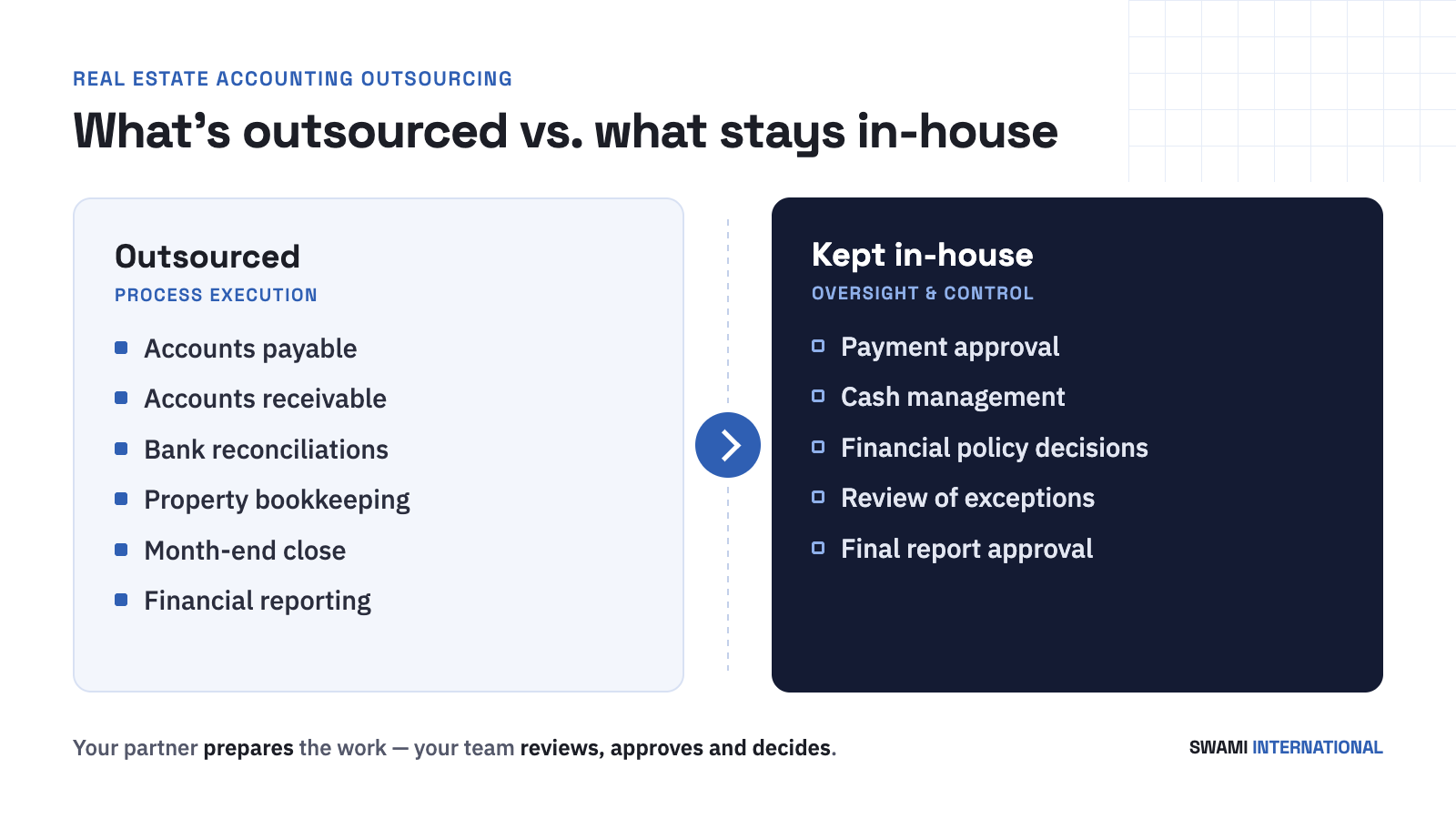
Management should still maintain appropriate oversight over cash, approvals, financial policies, reporting requirements and other critical controls.
Why Is Real Estate Accounting Different From General Accounting?
At first glance, real estate accounting may appear similar to accounting for any other business.
There are income statements, balance sheets, expenses, bank accounts, invoices and payments.
The difference is the level of detail and the number of relationships that need to be maintained.
A property management company may need to understand financial performance by:
A single transaction may also have implications beyond the general ledger.
For example, a vendor invoice may need to be allocated to a particular property and expense category. A tenant payment needs to be recorded against the appropriate tenant account. Owner distributions need to be tracked correctly. Property-level financial statements need to reconcile with the company's broader books.
This is why real estate businesses often benefit from working with accounting professionals who understand property-level accounting and real estate operating workflows, rather than relying solely on general bookkeeping experience.
What Real Estate Accounting Functions Can Be Outsourced?
The exact scope should depend on the company's size, portfolio, internal team and existing processes.
01Accounts Payable
Accounts payable is one of the most common functions to outsource.
An outsourced team may support:
- Invoice processing
- Invoice coding
- Property allocation
- Vendor records
- Payment preparation
- Invoice tracking
- AP reporting
- Vendor reconciliation
For property managers handling hundreds of recurring vendor transactions, a structured AP process can significantly reduce administrative workload.
02Accounts Receivable
Accounts receivable processes may include:
- Recording tenant payments
- Maintaining receivable records
- Monitoring outstanding balances
- Applying payments
- Reconciling receivables
- Preparing receivable reports
Accurate accounts receivable information is particularly important for property managers because financial reporting and operational decisions depend on reliable tenant and property-level data.
03Bank Reconciliations
Bank reconciliation compares recorded transactions with bank activity to identify discrepancies and ensure that accounting records are complete and accurate.
For real estate companies with multiple properties, bank accounts or entities, reconciliation can become a substantial recurring workload.
An outsourced team can perform the reconciliation process according to documented procedures while internal management retains review and approval responsibilities.
04Property Bookkeeping
Property bookkeeping involves recording and organizing financial activity associated with individual properties or entities.
Depending on the portfolio, this can include:
- Rental income
- Operating expenses
- Vendor payments
- Property management fees
- Repairs and maintenance
- Utilities
- Insurance
- Taxes
- Capital expenditures
- Other property-level transactions
The objective is not simply to keep the books current. It is to ensure that management has reliable financial information about each property.
05Month-End Close
A consistent month-end close process is critical for property management companies.
A typical workflow may include:
- Completing transaction posting
- Reconciling bank accounts
- Reviewing accounts payable and receivable
- Recording required accruals and adjustments
- Reviewing property-level balances
- Completing financial statement preparation
- Investigating unusual variances
- Finalizing management reports
A standardized close process can help a growing company produce financial information more consistently from month to month.
06Financial Reporting
Outsourced accounting teams can also support recurring financial reporting.
Depending on the business, reports may include:
- Income statements
- Balance sheets
- Cash-flow information
- Property-level profit and loss statements
- Budget-to-actual reports
- Owner statements
- Rent rolls
- Accounts receivable reports
- Accounts payable reports
The reporting package should be designed around what management, owners, investors or other stakeholders actually need to make decisions.
What Does a Real Estate Accounting Outsourcing Workflow Look Like?
Successful outsourcing usually starts before the first transaction is processed.
A structured transition generally includes several stages.
Step 1Define the Scope
First, determine exactly what the outsourcing team will handle.
For example:
Outsourced
- AP processing
- Bank reconciliations
- Monthly bookkeeping
- Property-level reporting
Internal
- Payment approval
- Financial policy decisions
- Cash management
- Final management review
A clearly defined scope prevents gaps and duplicated work.
Step 2Document Existing Processes
The outsourcing team needs to understand how the company currently operates.
This may include:
- Accounting procedures
- Chart of accounts
- Property structures
- Approval workflows
- Reporting formats
- Month-end deadlines
- Vendor processes
- Reconciliation procedures
- Software workflows
Existing SOPs are useful, but they are not always complete. A good transition process should identify undocumented knowledge held by the internal team.
Step 3Establish Systems and Access
The teams then establish the appropriate technology access and workflow.
Depending on the business, this could involve accounting and property management platforms, document-management systems, reporting tools and communication platforms.
Software familiarity matters because the outsourcing partner needs to work within the client's existing processes rather than forcing unnecessary system changes.
Step 4Run the Transition
A transition may begin with a limited scope or a specific portfolio.
This allows both teams to identify issues before expanding the engagement.
During this stage, organizations should closely monitor:
Step 5Establish the Ongoing Operating Rhythm
Once the transition is complete, the outsourced team becomes part of the company's recurring workflow.
A typical operating rhythm might include:
Daily or weekly
- Transaction processing
- AP/AR activity
- Exception follow-up
- Reconciliation work
Monthly
- Month-end close
- Financial reporting
- Account reconciliations
- Management review
Quarterly or annually
- Additional reporting
- Audit support
- Tax preparation support
- Process reviews
The exact cadence should be designed around the company's requirements.
What Are the Benefits of Outsourcing Real Estate Accounting?
The benefits can vary depending on the company's size and outsourcing model.
01Increased Accounting Capacity
Growing portfolios create more transactions.
Instead of constantly adding individual employees as workload increases, an outsourced team can provide additional capacity across multiple accounting functions.
This can be particularly useful when internal employees are spending too much time on repetitive processing instead of higher-value activities.
02Access to Specialized Expertise
Real estate accounting has its own terminology, workflows and reporting requirements.
A specialized provider can bring experience with property-level accounting and the operating realities of real estate businesses.
03More Scalable Operations
An accounting structure that works for a small portfolio may become difficult to manage as the portfolio expands.
Outsourcing can provide a more flexible way to add accounting capacity as transaction volume and portfolio size change.
04Reduced Administrative Burden
Accounting work can consume significant management time when processes are fragmented.
Delegating defined processes allows management to spend more time on activities such as:
05More Consistent Processes
An experienced outsourcing team typically works from defined procedures, checklists and deadlines.
This can help create greater consistency across properties and accounting periods.
06Better Visibility Into Financial Performance
Outsourcing itself does not automatically improve reporting.
However, a well-designed accounting process can help establish more consistent reconciliations, reporting schedules and review procedures.
That can give management better information for decision-making.
Does Outsourcing Mean Giving Up Control?
No.
This is one of the most important misconceptions about outsourced accounting.
A strong outsourcing model should actually define control responsibilities more clearly.
For example, an organization may decide that:
| The outsourced team… | Internal management… |
|---|---|
| Prepares invoices | Approves payments |
| Performs reconciliations | Reviews reconciliation exceptions |
| Prepares financial reports | Reviews and approves final reports |
This separation can help maintain appropriate financial controls while allowing routine work to be performed externally.
The objective is not to remove management oversight.
The objective is to make sure management spends its time on review, decisions and exceptions rather than repetitive processing.
What Should You Look for in a Real Estate Accounting Outsourcing Partner?
Not every accounting outsourcing company is a real estate accounting specialist.
Before selecting a provider, evaluate several areas.
Industry Experience
Ask whether the team has experience working with:
- Property management companies
- Residential portfolios
- Commercial properties
- Real estate investors
- Multiple legal entities
- Property-level financial reporting
Accounting Expertise
Determine who will actually perform the work.
Look at:
- Accounting qualifications
- Real estate accounting experience
- Team structure
- Senior-level review
- Training procedures
Technology Experience
Ask whether the provider has experience with the software your organization already uses.
The objective should be a smooth workflow—not unnecessary disruption.
Defined Processes
The provider should be able to explain:
- How work is assigned
- Who reviews it
- How exceptions are handled
- How deadlines are tracked
- How errors are corrected
- How management receives reports
Communication
Outsourcing works best when communication responsibilities are clearly defined.
Establish:
- Primary points of contact
- Escalation procedures
- Reporting schedules
- Meeting cadence
- Response expectations
Data Security
Accounting teams handle sensitive financial and business information.
Before sharing access, ask about:
- Access controls
- User permissions
- Data security procedures
- Confidentiality
- Employee access
- Backup procedures
- Information-handling policies
Security should be evaluated as part of the outsourcing decision—not after implementation.
When Should a Property Management Company Consider Outsourcing Accounting?
There is no single portfolio size at which every company should outsource.
Instead, look at the operational symptoms.
Outsourcing may be worth considering when:
- Accounting work is consistently behind schedule.
- Month-end close takes too long.
- Internal employees spend too much time on repetitive transactions.
- Management is hiring accounting staff faster than expected.
- The business has difficulty finding specialized accounting talent.
- Financial reporting is inconsistent across properties.
- Reconciliations are frequently delayed.
- Portfolio growth is outpacing back-office capacity.
- Existing accounting employees are overloaded.
- Management wants to grow without building every back-office function internally.
The key question is not simply:
“Can we outsource accounting?”
A better question is:
“Which accounting processes should remain internal, and which can be handled more efficiently by a specialized external team?”
Outsourcing vs. Hiring an Internal Accounting Team
Both models can work.
The right choice depends on the company's requirements.
| Consideration | In-House Team | Outsourced Team |
|---|---|---|
| Direct control | High | Managed through defined processes |
| Recruiting | Internal responsibility | Provider responsibility |
| Training | Internal responsibility | Provider responsibility |
| Scalability | Requires additional hiring | Can often scale with workload |
| Industry expertise | Depends on hiring | Can be sourced from specialists |
| Management oversight | Direct | Through review and reporting |
| Staffing continuity | Dependent on individual employees | Supported by team structure |
| Fixed overhead | Typically higher | Can be structured around scope |
The decision should be based on more than cost.
Companies should consider capacity, expertise, control, scalability, continuity and the complexity of their portfolio.
Common Mistakes When Outsourcing Real Estate Accounting
Outsourcing can create significant value, but only when implemented properly.
Mistake 1Choosing a General Bookkeeper Instead of a Real Estate Specialist
Real estate accounting involves property-specific workflows that a general bookkeeping provider may not understand.
Mistake 2Outsourcing Without Defining Responsibilities
If both teams assume the other team is handling a task, important work can fall through the cracks.
Mistake 3Focusing Only on Price
The lowest-cost provider is not necessarily the lowest-cost solution if errors, delays or rework follow.
Mistake 4Failing to Document Processes
A provider cannot consistently reproduce a process that has never been clearly defined.
Mistake 5Removing Internal Oversight
Outsourcing accounting does not mean outsourcing management responsibility.
Mistake 6Ignoring Software Compatibility
The provider should understand the systems and workflows used by the business.
Mistake 7Trying to Outsource Everything at Once
A phased approach can make transition and quality control easier.
A Practical Checklist Before Outsourcing
Before selecting an outsourcing partner, ask:
Scope
- Which accounting functions need support?
- Which tasks must remain internal?
- What is the expected transaction volume?
- How many properties and entities are involved?
Expertise
- Does the provider have real estate accounting experience?
- Does the team understand property-level accounting?
- Who performs the work?
- Who reviews the work?
Technology
- Does the provider know our accounting or property management software?
- How will documents and data be exchanged?
- What access will the team require?
Process
- What happens during transition?
- Are SOPs documented?
- How are errors and exceptions handled?
- What are the month-end deadlines?
Controls
- Who approves payments?
- Who has bank access?
- Who reviews reconciliations?
- How are sensitive financial records protected?
Reporting
- What reports will we receive?
- When will they be delivered?
- Who reviews them?
- Can reporting be customized by property or entity?
Communication
- Who is our primary contact?
- How are urgent issues escalated?
- How often will the teams meet?
The Bottom Line
Real estate accounting outsourcing is not simply a cost-cutting exercise.
Done properly, it can become a capacity, process and scalability strategy for a growing real estate business.
The most effective model is one in which the outsourcing team handles clearly defined accounting and back-office processes while company leadership retains appropriate oversight and decision-making authority.
For property management companies and real estate businesses, the goal should be straightforward:
Accurate books. Consistent processes. Timely reporting. Scalable accounting capacity.
The right outsourcing partner should help achieve all four without creating another layer of operational complexity.
How Swami International Supports Real Estate Back-Office Operations
Swami International Back Office Services works with U.S.-based property management companies, real estate partnerships and financial institutions, providing specialized back-office support across property accounting, partnership taxation, financial spreading and loan sizing.
Our India-based team supports U.S. real estate operations across residential and commercial portfolios and works as an extension of clients' existing teams.
Our services include:
- Property management back-office support
- Accounts payable and accounts receivable
- Bank reconciliations
- Lease administration
- Financial reporting
- U.S. real estate partnership tax support
- Form 1065 and Schedule K-1 support
- Financial spreading
- Commercial real estate loan sizing
- Additional accounting and business support
If your real estate business is growing faster than your internal accounting capacity, the first step is not necessarily to outsource everything.
It is to identify where additional expertise, process support and capacity can create the greatest operational value.
Explore our real estate back-office servicesTalk to our team →
This article is provided for general informational purposes and should not be considered accounting, tax, legal or financial advice. Specific requirements vary by business, entity structure, property type and jurisdiction.