
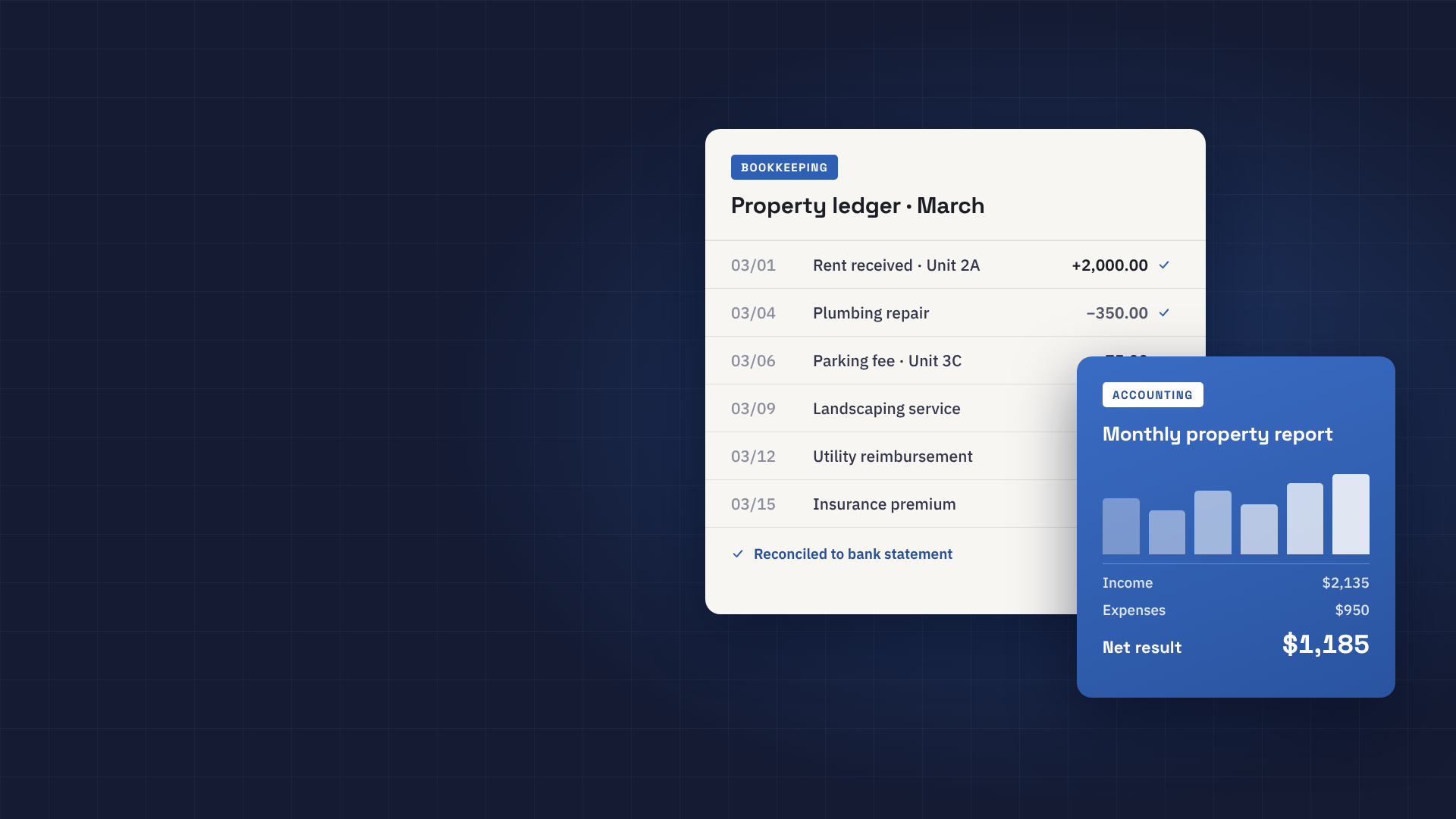
Real estate businesses handle a steady flow of financial transactions. Rent payments come in, vendors need to be paid, operating expenses must be tracked, security deposits need to be recorded, and property owners expect accurate financial reports. Managing these activities requires reliable financial processes.
Two terms often come up when discussing these responsibilities: bookkeeping and accounting. Although they are closely related, they serve different purposes.
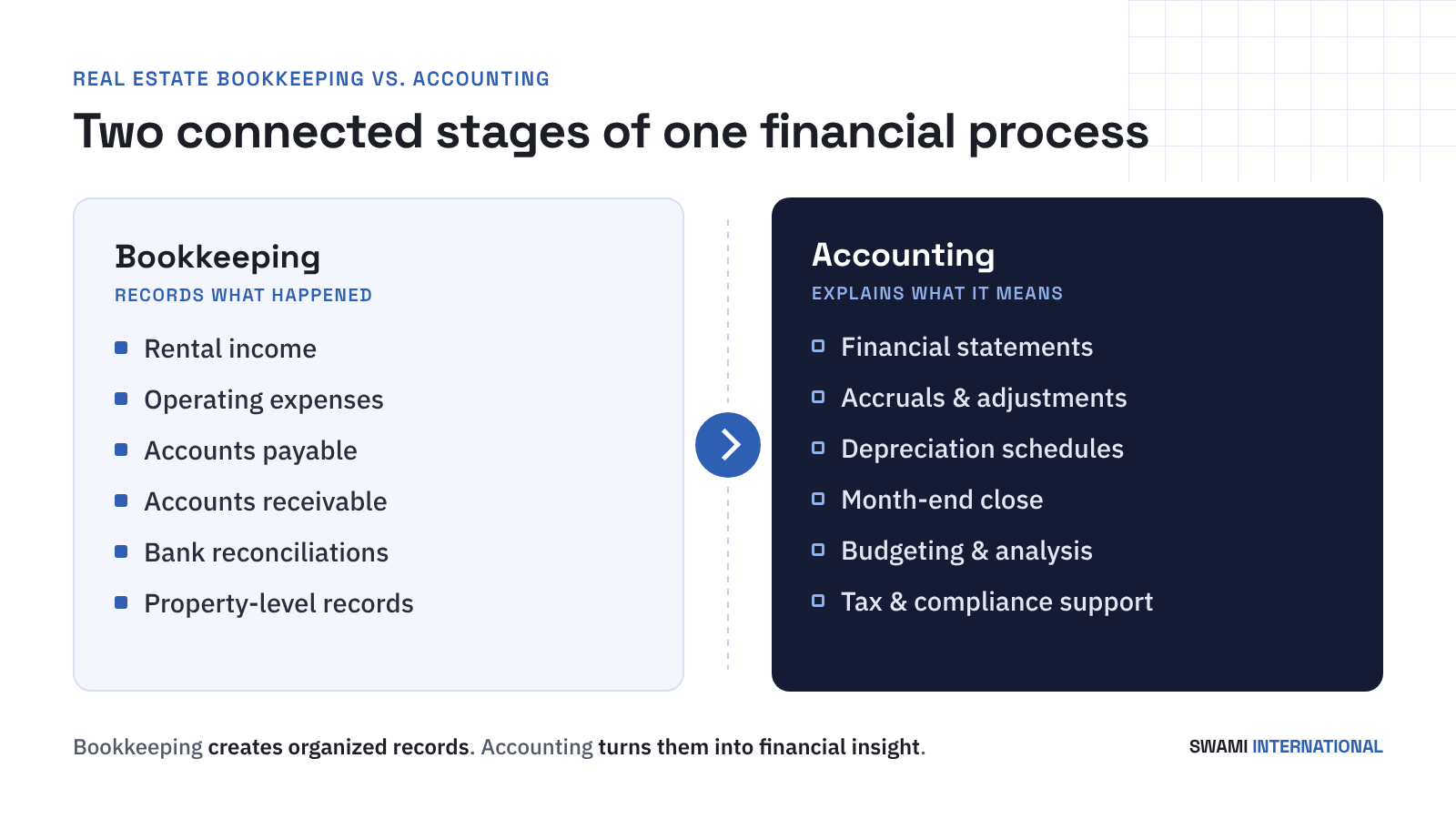
Bookkeeping focuses on recording and organizing financial transactions. Accounting takes that financial information further by analyzing it, interpreting results, preparing reports, and supporting business decisions.
For property management companies, real estate investors, and other real estate businesses, understanding the difference is important. Both functions contribute to accurate financial records, effective cash management, and informed decision-making.
In this guide, we explain how real estate bookkeeping differs from accounting, what each function includes, when a business needs both, and how to determine the right level of financial support.
In short
- Bookkeeping records and organizes what happened financially: rent received, expenses paid, invoices, reconciliations and property-level records.
- Accounting reviews, adjusts, reports and analyzes those records to explain what they mean for the business.
- Real estate businesses of every size need both. The level of support depends on portfolio size, transaction volume and reporting requirements.
What Is Real Estate Bookkeeping?
Real estate bookkeeping is the process of recording, organizing, and maintaining the financial transactions associated with real estate operations.
It creates the underlying financial records that a business relies on to understand its income, expenses, balances, and cash activity.
For a property management company, bookkeeping may involve recording rental income, tracking vendor invoices, categorizing property expenses, reconciling bank accounts, and maintaining records for individual properties and owners.
Common Real Estate Bookkeeping Responsibilities
Typical bookkeeping tasks include:
01Recording rental income
Bookkeepers record rent payments and other tenant-related income. Depending on the business structure, this may include base rent, parking fees, utility reimbursements, late fees, and other charges.
Transactions should be assigned to the correct property, unit, tenant, and accounting period.
02Recording operating expenses
Real estate businesses incur expenses such as maintenance, repairs, utilities, insurance, property taxes, landscaping, cleaning, and management fees.
Bookkeeping ensures these transactions are recorded consistently and categorized appropriately.
03Accounts payable support
Accounts payable activities involve recording vendor invoices, tracking outstanding bills, maintaining payment records, and monitoring due dates.
For property management companies, this can include payments to maintenance contractors, utility providers, insurance companies, and other service vendors.
04Accounts receivable tracking
Bookkeeping also supports the tracking of amounts owed to the business, including unpaid rent, tenant charges, reimbursements, and other outstanding balances.
Accurate records help management identify overdue accounts and follow up appropriately.
05Bank and credit card reconciliation
Reconciliation involves comparing recorded transactions with bank and credit card statements to identify differences, missing entries, duplicate transactions, or incorrect amounts.
Regular reconciliation helps maintain accurate cash balances.
06Maintaining property-level records
Real estate businesses often manage multiple properties, each with its own income and expenses.
Bookkeeping helps maintain separate financial records for each property, making it easier to monitor performance and prepare owner-level reporting.
07Maintaining supporting documentation
Invoices, receipts, payment confirmations, bank statements, and other financial documents should be organized and retained. Proper documentation supports internal reviews, financial reporting, and tax preparation.
What Is Real Estate Accounting?
Real estate accounting involves interpreting, analyzing, reviewing, and reporting the financial information generated through bookkeeping.
While bookkeeping records what happened financially, accounting helps explain what those transactions mean for the business.
Accounting provides a broader view of financial performance, profitability, cash flow, liabilities, and financial position. It also helps business owners and management teams make informed decisions.
Common Real Estate Accounting Responsibilities
01Preparing financial statements
Accounting professionals prepare and review financial statements, including:
- Income statements or profit and loss statements
- Balance sheets
- Cash flow statements
These reports help management understand financial performance and the overall financial position of the business.
02Reviewing financial accuracy
Accounting includes reviewing recorded transactions, account balances, reconciliations, and supporting documentation to identify inconsistencies and potential errors.
This review helps improve the reliability of financial information.
03Property-level and corporate-level reporting
Property-level reporting shows the income, expenses, and financial performance of individual properties. Corporate-level reporting provides an overview of the management company's or ownership entity's overall financial position.
Accounting helps ensure these reporting structures are properly maintained.
04Accruals and adjusting entries
Accounting may require recording transactions in the appropriate accounting period, even when cash has not yet been received or paid.
Examples include accrued expenses, prepaid expenses, depreciation, and other adjusting entries that help financial statements reflect the correct period's activity.
05Fixed asset and depreciation accounting
Real estate businesses may own buildings, equipment, appliances, vehicles, and other assets.
Accounting helps track qualifying assets, record capital expenditures, calculate depreciation where applicable, and maintain asset schedules.
06Budgeting and financial analysis
Accounting information can support budgeting, forecasting, expense analysis, and performance comparisons.
For example, management may compare actual maintenance expenses against budgeted amounts or review a property's operating performance over several periods.
07Month-end and year-end close
Accounting teams coordinate the closing process to ensure transactions are recorded, accounts are reconciled, adjustments are completed, and financial reports are prepared.
A structured close process improves the consistency and timeliness of financial reporting.
08Tax and compliance support
Accounting records provide essential information for tax preparation and financial compliance. Depending on the engagement, accounting professionals may help organize tax schedules, maintain supporting records, and coordinate information required by tax professionals.
Tax advice and filings should be handled by appropriately qualified professionals.
Real Estate Bookkeeping vs. Accounting: Key Differences
Although bookkeeping and accounting work together, their responsibilities and objectives are different.
| Area | Real estate bookkeeping | Real estate accounting |
|---|---|---|
| Primary purpose | Record and organize transactions | Analyze, review, and report financial information |
| Main focus | Day-to-day financial activity | Overall financial accuracy and performance |
| Rental income | Records rent received | Reviews income recognition and reporting |
| Expenses | Records and categorizes expenses | Analyzes expenses and prepares adjustments |
| Vendor payments | Records invoices and payments | Reviews liabilities and financial impact |
| Reconciliation | Performs routine reconciliations | Reviews reconciliation results and resolves complex issues |
| Financial statements | Supplies underlying records | Prepares and reviews financial statements |
| Property reporting | Maintains property-level transaction data | Analyzes property performance |
| Adjusting entries | Generally follows established procedures | Determines and records appropriate adjustments |
| Financial analysis | Limited routine reporting | Supports budgeting, forecasting, and decision-making |
| Month-end close | Completes assigned transaction tasks | Oversees or coordinates the broader close process |
Bookkeeping creates organized financial records. Accounting turns those records into meaningful financial information.
How Bookkeeping and Accounting Work Together in Property Management
For property management companies, bookkeeping and accounting are not separate activities that operate independently. They form connected stages of one financial management process.
Consider a practical example involving a rental property. A tenant pays $2,000 in monthly rent. The property also incurs a $350 plumbing repair expense during the same month.
Step 1 · BookkeepingRecord the transactions
The bookkeeper records the $2,000 rent payment and assigns it to the correct property and tenant account. The $350 plumbing invoice is recorded under the appropriate repair and maintenance expense category.
Step 2 · BookkeepingReconcile the transactions
The recorded rent deposit and plumbing payment are compared against the bank statement. Any differences are investigated and corrected.
Step 3 · AccountingReview the financial information
The accounting team reviews the recorded income and expenses, checks the relevant account balances, and determines whether any additional entries or adjustments are necessary.
Step 4 · AccountingPrepare financial reports
The property's financial report reflects the recorded rental income and expenses.
| Example: one property, one month | Amount |
|---|---|
| Rental income received | $2,000 |
| Plumbing repair expense | ($350) |
| Difference before other expenses and adjustments | $1,650 |
Based only on these two transactions, the difference between rental income and the repair expense is $1,650. This is not necessarily the property's final profit, because other expenses, accruals, and adjustments may also apply.
Step 5 · ManagementUse the information
The property manager or owner can review the financial results, monitor expenses, and assess whether additional attention is needed.
- Record
- Reconcile
- Review
- Report
- Decide
This example demonstrates why both functions are necessary. Without bookkeeping, the financial records may be incomplete. Without accounting, management may lack the analysis and reporting needed to understand the property's financial position.
Why Real Estate Businesses Need Both Bookkeeping and Accounting
Real estate businesses often manage complex financial activity across multiple properties, tenants, vendors, bank accounts, and ownership entities.
Relying on bookkeeping alone may provide transaction records but not the financial analysis needed for effective management. Relying on accounting without accurate underlying records can lead to unreliable reports and time-consuming corrections. Combining both functions provides several advantages.
01More accurate financial records
Consistent bookkeeping creates an organized transaction history. Accounting reviews and validates that information, helping identify errors and inconsistencies.
02Better property-level financial visibility
Maintaining accurate income and expense records for individual properties allows management to evaluate performance and identify properties with unusual costs or declining financial results.
03Improved cash flow management
Tracking rent collections, outstanding receivables, vendor payments, and upcoming expenses helps management understand cash requirements and plan accordingly.
04More reliable owner reporting
Property owners expect transparent reporting about income, expenses, payments, and property performance. Bookkeeping maintains the supporting transaction details, while accounting helps ensure reports are accurate, consistent, and understandable.
05Stronger financial controls
Reconciliations, account reviews, approval procedures, and proper documentation help reduce errors and improve accountability.
06Better support for business decisions
Accounting reports can help management evaluate operating costs, compare property performance, prepare budgets, and identify opportunities to improve financial efficiency.
07Easier tax preparation
Organized bookkeeping records and properly maintained accounting schedules make it easier to gather financial information for tax preparation and professional review.
Do Small Real Estate Businesses Need Both?
Yes.
Even small real estate businesses benefit from having both bookkeeping and accounting functions. However, the level of support required depends on the size, complexity, and structure of the business.
Investor with one or two rentals
- Relatively straightforward bookkeeping
- Periodic account reviews
- Annual financial reporting
Company managing hundreds of units
- Regular rental income and expense recording
- Tenant accounts receivable tracking
- Vendor accounts payable management
- Multiple bank account reconciliations
- Property-level financial reporting
- Owner statements and distributions
- Monthly close procedures
- Corporate-level financial reporting
- Budgeting and financial analysis
The important consideration is not whether a business is large or small. It is whether its financial processes are sufficient to maintain accurate records and support its operational requirements.
When Should a Real Estate Business Hire a Bookkeeper?
A business may need dedicated bookkeeping support when financial transaction volume becomes difficult to manage internally. Common indicators include:
- Rental payments are not consistently recorded or matched to tenant accounts
- Vendor invoices and payment records are becoming disorganized
- Bank reconciliations are frequently delayed
- Management is spending too much time entering transactions
- Property-level income and expense records are incomplete
- Outstanding tenant balances are difficult to track
- Financial documents are scattered across different systems
A bookkeeper can help establish consistent transaction recording, reconciliation, and documentation processes.
When Should a Real Estate Business Hire an Accountant?
Accounting support becomes especially important when a business needs more than transaction recording. Consider professional accounting support when:
- Financial statements are needed regularly
- Management needs property-level profitability analysis
- The business operates through multiple entities
- Month-end closing takes too long or produces inconsistent results
- Accruals, depreciation, or adjusting entries require attention
- Management needs budgeting and forecasting support
- Financial records must be prepared for lenders, investors, or tax professionals
- The business is expanding and needs stronger financial controls
For growing property management companies, accounting support can help establish reporting standards and scalable financial processes. Our complete guide to property management accounting covers these processes in more detail.
Should You Outsource Real Estate Bookkeeping and Accounting?
Real estate businesses do not necessarily need to hire separate full-time employees for every financial function. Depending on their needs, they may choose to manage bookkeeping and accounting internally, outsource selected tasks, or use a combination of in-house and outsourced support.
Outsourcing can be particularly useful when transaction volumes increase, internal teams become overloaded, or management needs more consistent financial reporting.
Benefits of outsourcing
Access to specialized support
An outsourcing partner familiar with real estate operations may understand property-level accounting, tenant transactions, vendor payments, reconciliations, and owner reporting requirements.
Scalable financial operations
Businesses can adjust the level of support as their portfolios and transaction volumes change.
More time for core operations
Property managers and business owners can spend less time on routine financial administration and more time on operations, leasing, customer service, and growth.
Improved process consistency
A structured outsourcing arrangement can establish standard procedures for transaction recording, reconciliations, reporting, and month-end closing.
Potential cost efficiency
Outsourcing may reduce the need to recruit, train, and maintain an entirely in-house finance team. Actual savings depend on service scope, transaction volume, technology, and oversight requirements.
What should you consider before outsourcing?
Evaluate any provider on:
- Experience with real estate and property management accounting
- Understanding of property-level and entity-level reporting
- Data security and access controls
- Accounting software compatibility
- Reconciliation and review procedures
- Reporting frequency and turnaround times
- Communication and escalation processes
- Clearly defined responsibilities and approval authority
Outsourcing does not remove the business's responsibility to oversee its financial processes. Internal management should retain appropriate review, approval, and control procedures. For a deeper look, see when a property management company should outsource its accounting and our guide to real estate accounting outsourcing.
Common Mistakes When Confusing Bookkeeping With Accounting
Treating bookkeeping and accounting as interchangeable can create gaps in financial management. Here are some common mistakes real estate businesses should avoid.
Mistake 1Assuming transaction recording is enough
Recording rent and expenses does not automatically provide a complete picture of financial performance. Businesses also need account reviews, appropriate adjustments, and meaningful reporting.
Mistake 2Delaying bank reconciliations
When reconciliations are postponed, errors and missing transactions can accumulate. This makes it harder to determine whether reported cash balances are accurate.
Mistake 3Ignoring property-level financial information
Combining all property transactions into broad accounts without adequate tracking can make it difficult to evaluate individual property performance.
Mistake 4Not reviewing financial statements
Financial reports are most useful when management reviews them regularly and investigates unusual balances, unexpected expenses, and significant changes.
Mistake 5Failing to establish month-end procedures
Without a structured closing process, financial reports may be delayed or inconsistent from month to month.
Mistake 6Assigning responsibilities without clear controls
The same person may perform multiple bookkeeping and accounting tasks in a small organization. However, businesses should establish suitable review and approval controls, especially for payments and financial adjustments.
How Technology Supports Real Estate Bookkeeping and Accounting
Accounting software and property management platforms have made it easier to manage financial information across multiple properties. Depending on the platform and configuration, these systems can support:
However, software does not eliminate the need for accurate accounting procedures. Transactions still need to be categorized correctly, exceptions must be reviewed, reconciliations completed, and financial reports checked.
The most effective approach combines suitable technology with well-defined bookkeeping and accounting workflows.
How to Build an Effective Bookkeeping and Accounting Process
Real estate businesses can improve financial management by establishing a consistent workflow. A practical framework includes:
- Define the accounting structureEstablish the appropriate accounts, property tracking categories, ownership entities, and reporting requirements.
- Record transactions regularlyEnsure rental income, vendor invoices, expenses, deposits, and other financial activity are recorded promptly.
- Maintain supporting documentsOrganize invoices, receipts, statements, payment confirmations, and other relevant records.
- Reconcile bank accountsPerform regular reconciliations and investigate differences instead of allowing unresolved items to accumulate.
- Review financial balancesCheck accounts receivable, accounts payable, cash balances, security deposit liabilities, and other important accounts.
- Complete the month-end closeRecord necessary adjustments, review account balances, and finalize the reporting period.
- Prepare and review financial reportsGenerate property-level and corporate-level reports according to management's requirements.
- Use financial information to improve operationsReview trends, investigate unusual expenses, monitor outstanding balances, and use reporting insights to support business decisions.
Frequently Asked Questions
Is bookkeeping the same as accounting in real estate?
No. Bookkeeping focuses on recording and organizing financial transactions, while accounting involves reviewing, analyzing, adjusting, and reporting that financial information. Both functions are important for effective real estate financial management.
Can a bookkeeper prepare financial statements?
A bookkeeper can maintain the records used to prepare financial statements and may prepare routine reports depending on their training and assigned responsibilities. More complex accounting reviews, adjustments, and reporting requirements may require an accountant.
Does a property management company need an accountant?
Most property management companies benefit from accounting support, particularly when they manage multiple properties, handle owner funds, prepare financial statements, or need regular financial analysis. The level of support depends on the company's size and complexity.
What is the difference between a real estate bookkeeper and a real estate accountant?
A real estate bookkeeper generally records rental income, expenses, invoices, payments, and reconciliations. A real estate accountant focuses on reviewing those records, preparing financial statements, managing adjustments, analyzing property performance, and supporting financial reporting.
Can real estate bookkeeping and accounting be outsourced together?
Yes. Businesses can outsource both functions through a provider that offers the required scope of services. Responsibilities, review procedures, access permissions, and reporting expectations should be clearly defined before the engagement begins.
How often should real estate accounts be reconciled?
Bank and credit card accounts should generally be reconciled at least monthly. Businesses with high transaction volumes or more complex operations may benefit from more frequent reconciliation.
Is real estate bookkeeping different from regular bookkeeping?
The underlying bookkeeping principles are similar, but real estate bookkeeping often requires additional tracking for individual properties, tenants, leases, security deposits, owner accounts, and property-related expenses.
Final Thoughts
Real estate bookkeeping and accounting are closely connected, but they serve different purposes.
Bookkeeping establishes the foundation by recording and organizing financial transactions. Accounting builds on that foundation through financial reviews, adjustments, reporting, and analysis.
For property management companies and real estate businesses, both functions are essential to maintaining accurate records, monitoring property performance, managing cash flow, and supporting informed decisions.
As a real estate business grows, its financial processes should grow with it.
Whether managed internally or through an experienced outsourcing partner, a well-organized bookkeeping and accounting system can help create greater financial visibility and more efficient operations.
Explore Swami International Back Office Services
Swami International Back Office Services supports real estate businesses with accounting and back-office services designed to help streamline financial operations and support consistent reporting.
Explore our services to learn how professional real estate accounting support can fit into your business operations.
Disclaimer: This article is for general informational purposes only and should not be considered accounting, tax, legal, or financial advice. Specific accounting and reporting requirements may vary based on business structure, applicable accounting standards, and jurisdiction. Consult a qualified professional regarding your circumstances.
